At many Mandarin Restaurants in Ontario, an all-you-can-eat meal can begin with someone placing a warm towel in your hands.
That is a small thing.
It is also a revealing one.
You are about to serve yourself from a buffet that may stretch roughly 150 feet. There may be hundreds of people in the building. Yet someone has greeted you, shown you to a table and given you a warm towel before you have picked up a plate.
During the meal, used dishes tend to disappear quickly. Drinks are watched. Staff circulate. At some locations, another warm towel arrives when the meal is over.
In other words, the food may be self-service.
The hospitality is not.
That distinction helps explain Mandarin Restaurant, a Canadian company that has quietly built what appears to be North America’s largest unified Chinese buffet chain – 29 enormous restaurants, all of them in Ontario, and a style of buffet dining that treats atmosphere and service as seriously as abundance.
It Began as One Small Restaurant
Mandarin did not begin as a buffet.
James Chiu, George Chiu, K.C. Chang and Diana Chiu founded the company on December 8, 1979, after moving to Ontario and buying a small Chinese-Canadian restaurant on Queen Street in Brampton. The restaurant offered a la carte dining, takeout and delivery.
Then came the useful kind of restaurant problem: too many customers.
The founders expanded the restaurant repeatedly as lines grew. By 1986, the Brampton location had reached about 9,000 square feet, and Mandarin made the decision that would define the company.
It became a buffet.
James Chiu later explained the logic simply: an a la carte menu could not make everybody happy. A buffet could give far more people something they wanted.
The change did not eliminate the lines. It created more of them.
By 1988, loyal employees from the original restaurant had become partners in a second Mandarin in Mississauga. More Ontario locations followed through the 1990s, and the small Brampton restaurant gradually became the foundation for something much larger.
Twenty-Nine Restaurants, Each the Size of a Small Institution
Mandarin’s current scale is difficult to appreciate until you put numbers around it.
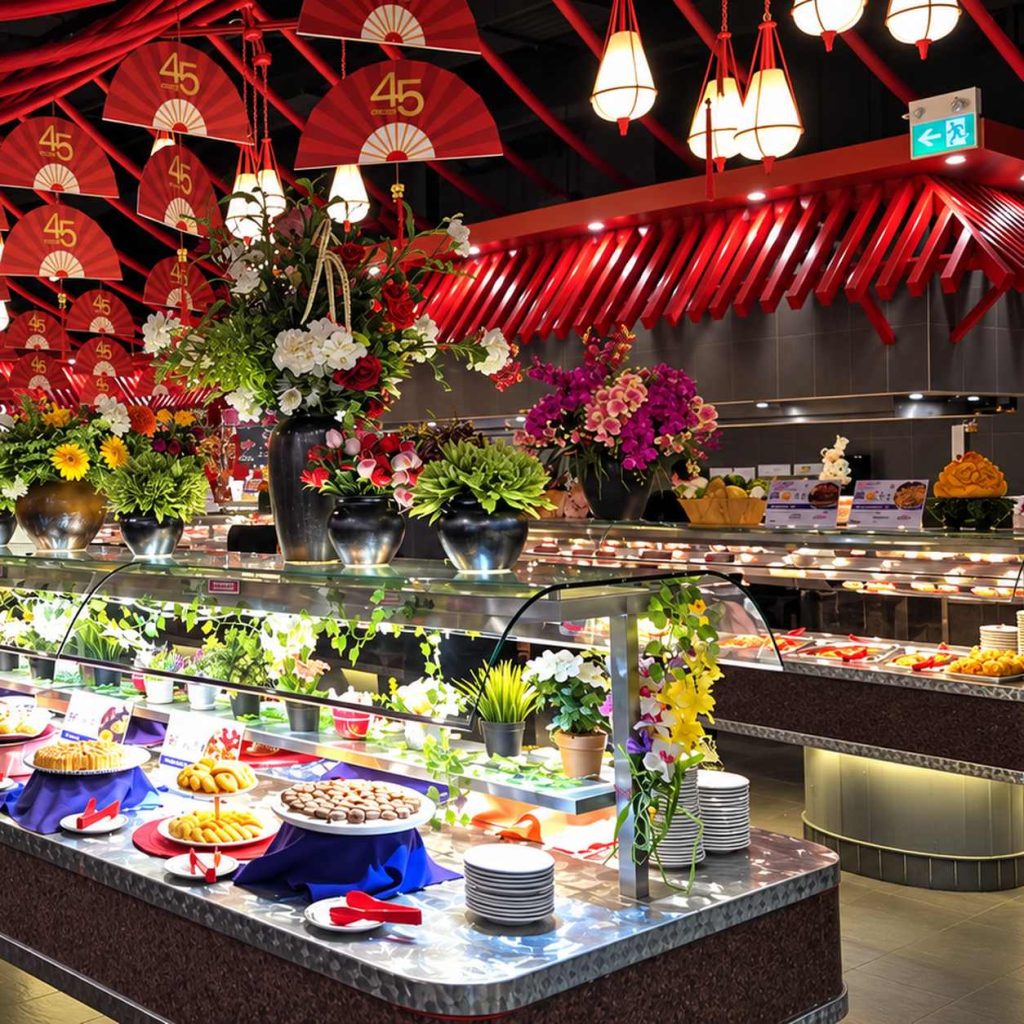
The company says its 29 Ontario restaurants average roughly 12,000 to 15,000 square feet. A typical location seats 300 to 500 diners, employs about 100 people and contains approximately 150 linear feet of buffet tables.
One hundred and fifty feet.
That is not a steam table tucked against the wall of a neighborhood Chinese restaurant. It is an operating system built around volume.
And in the Chinese-buffet world, 29 locations is an unusual number. The United States has roughly 1,200 Chinese buffets, but they are overwhelmingly independent or small regional operations. One of the larger recognizable U.S. Asian buffet chains, Lin’s Grand Buffet, currently describes itself as having 18 locations.
Mandarin is something quite different: a mature regional Chinese buffet brand with centralized training, standardized operations, seasonal marketing, substantial real estate and a restaurant footprint that has remained almost entirely concentrated in one Canadian province.
The Buffet Is Self-Service. The Restaurant Is Not.
Buffets contain an obvious temptation for restaurant operators: once customers are getting their own food, why not let the rest of the experience become equally transactional?
Mandarin seems to have spent decades resisting that idea.
Its stated service philosophy is unusually explicit. The company has said that customers should feel welcomed when they arrive and happy when they leave. Founder James Chiu has put it another way: in a restaurant business increasingly surrounded by technology and convenience, ‘the human touch is what matters.’
You can see that philosophy in the details.
Recent accounts from multiple Mandarin locations describe front-door greetings, servers keeping beverages filled, plates disappearing almost as soon as they are finished, managers circulating through dining rooms and the small ritual of warm towels before or after the meal.
No single gesture is extravagant.
Together, they change how a buffet feels.
A person can walk back to the food as many times as desired without the restaurant ever communicating that service has stopped simply because the customer is serving the entree.
The Management System Is Almost as Interesting as the Buffet
Mandarin’s service culture becomes easier to understand when you look at how the restaurants are managed.
James Chiu has described the company’s structure as more of a partnership system than a conventional franchise arrangement. A new restaurant traditionally has five managing partners: two chefs and three front-of-house managers.
The important part is where those partners come from.
They begin as Mandarin employees.
Potential partners are nominated from within the company and sent through roughly two years of training. They work full time at the Brampton flagship while attending classes and seminars on restaurant management during evenings and weekends.
Two years.
For a buffet manager.
Chiu’s shorthand for the philosophy is memorable: ‘No train, no gain.’ The larger idea is more serious. Mandarin wants the people running its restaurants to understand operations, teamwork and service before they become hands-on owners of the business.
That is a remarkably high bar in a restaurant category that is often assumed to compete primarily on price and quantity.
These Restaurants Are Meant to Feel Like Places
Mandarin also spends an unusual amount of effort making its restaurants feel like somewhere you went, not merely somewhere you ate.
With dining rooms large enough for hundreds of people, scale could easily become institutional. Instead, locations commonly use aquariums, murals, decorative lighting, seasonal ornamentation and separate dining areas to break up the space. Depending on the restaurant, diners may encounter themed rooms, fish tanks, koi, Chinese decorative elements or softly playing music.
The flagship in Brampton takes the idea much further.
When Mandarin opened its corporate headquarters complex in 2002, the project totaled more than 62,000 square feet. Inside was a 20,000-square-foot flagship restaurant with a waterfall, aquariums and an aviary, along with an 800-seat banquet and convention centre.
A waterfall.
An aviary.
At a Chinese buffet.
That sounds wonderfully excessive until you understand Mandarin’s larger positioning. The company has long described itself as ‘A Special Place for Special Occasions.’ Birthdays, family gatherings, work dinners and celebrations are not side business. They are part of what the restaurants are designed to accommodate.
And Behind the Waterfall Is a Microbiology Lab
Then there is the detail that might explain Mandarin better than almost anything else.
The same Brampton corporate complex that contains the waterfall and flagship restaurant also contains Mandarin’s head office and its own food-safety microbiology laboratory.
That juxtaposition is almost perfect.
Out front: aquariums, decorative rooms, celebrations and a buffet measured in hundreds of feet.
Behind the scenes: laboratory work devoted to food safety.
A buffet company has to care about both. A dining room can look beautiful, but the operating challenge is still enormous: dozens upon dozens of foods held at proper temperatures, constantly replenished, handled by hundreds of customers and served to enormous volumes of people.
Mandarin’s answer has been to treat that invisible infrastructure as part of the business rather than something separate from hospitality.
A Buffet That Refuses to Stand Still
Mandarin has also resisted another familiar buffet problem: becoming a museum of the dishes that were popular when the restaurant first opened.
The buffet has expanded continuously.
A grill section arrived in 1993. Fresh sushi followed in 2003. By 2013, Mandarin had added all-you-can-eat sashimi, self-serve frozen yogurt and cotton candy. Today the company promotes more than 100 buffet dishes.
James Chiu once summarized the buffet operator’s dilemma in eight words: ‘A buffet must keep expanding: it cannot be reduced.’
Mandarin also uses the calendar to keep the experience changing. Chinese New Year brings its own foods and decoration. The Moon Festival adds seasonal dishes and lantern displays. Christmas has historically brought limited-time turkey, ham and holiday drinks.
The seasonal menus are not radical reinventions of the restaurant. That is precisely why they work. A regular customer can still find the Mandarin dishes they came for, while the room and a portion of the buffet give them something new to notice.
For a mature buffet chain, that may be one of the harder balances to maintain: familiarity without stagnation.
Scale Without Surrendering the Details
There is an easy way to misunderstand Mandarin.
You could look at 29 restaurants, 300 to 500 seats per location, more than 100 dishes and 150 feet of buffet and conclude that the achievement is simply scale.
The scale is impressive.
But it is not the most interesting part.
The more revealing story is that Mandarin built enormous self-service restaurants and then surrounded the self-service with systems designed to make the experience feel attended to.p>
That is why Mandarin is such an interesting benchmark for buffet dining.
A buffet does not have to choose between abundance and hospitality.
Mandarin’s 29 Ontario restaurants are evidence that, with enough discipline, a company can make room for both.
And if the first thing placed in your hands is a warm towel before you have even picked up a plate, you understand the philosophy rather quickly.