If you live in much of the United States, the phrase “Mexican buffet” can sound like a restaurant category somebody should have invented but somehow did not.
Chinese buffets are familiar. Indian lunch buffets are familiar. Pizza buffets are familiar. Mexican restaurants are everywhere.
And yet a person can eat Mexican food for decades without ever encountering an all-you-can-eat version of it.
Then you travel somewhere else and discover that people have opinions about which Mexican buffet they prefer.
That may be the first interesting thing about Mexican buffets in America.
They are not exactly rare.
They are strangely regional.
Mexican All-You-Can-Eat Is Older Than You Might Think
The story begins considerably earlier than the modern American buffet boom.
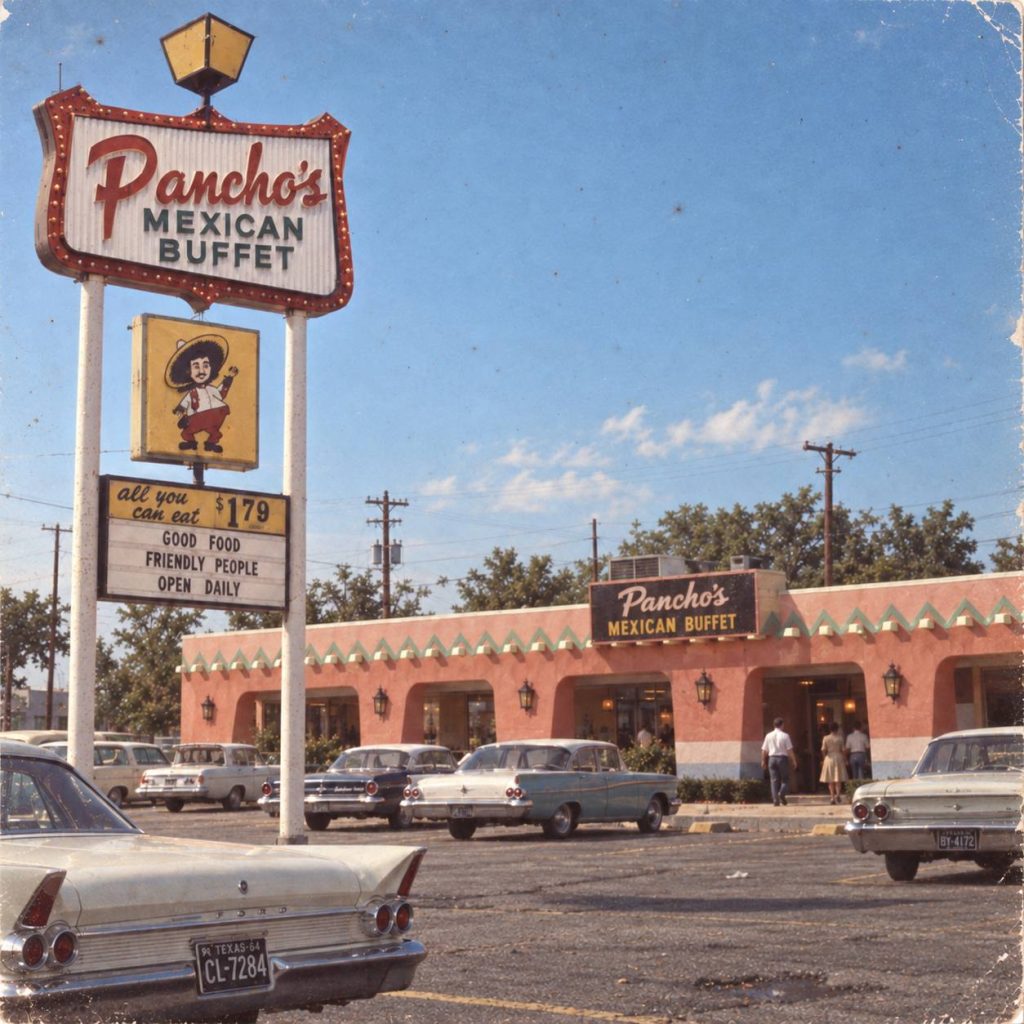
Pancho’s Mexican Buffet opened in El Paso, Texas, in 1958. The idea was straightforward: build an entire family restaurant around unlimited Mexican and Tex-Mex food.
Pancho’s eventually added one of the more memorable service rituals in buffet history. Small Mexican flags sat on the tables. When customers wanted more food, they raised the flag and a server came over.
It sounds almost theatrical now.
At the time, it became the identity of a serious regional restaurant chain.
And Pancho’s was not an isolated experiment. By the 1960s, restaurants in Austin were already advertising all-you-can-eat Mexican dinners.
Long before endless wings, endless shrimp and modern hot-pot packages, Americans were already paying one price for as much Tex-Mex as they wanted.
For a While, the Buffet Was the Restaurant
Pancho’s represents the clearest version of the original model.
The buffet was not available only on weekdays from 11 to 2.
It was not a Sunday promotion.
The buffet was the restaurant.
By 1982, Pancho’s had 28 locations. Five years later it had 45 and was expanding rapidly. In 1987, its all-you-can-eat meal still cost $3.99.
The chain eventually reached 77 restaurants in 1994, concentrated largely in Texas and the surrounding Southwest.
Seventy-seven Mexican buffet restaurants.
There was a period when a full-time Mexican buffet chain was a recognizable part of the American restaurant landscape.
But the old model proved difficult to sustain. Pancho’s struggled with stagnant sales, increasing costs and underperforming restaurants. Stores closed. The company experimented with new formats. The chain gradually contracted.
Only a handful of Pancho’s restaurants remain today.
The little flags remain, too.
Then the Mexican Buffet Became Harder to See
If Mexican buffets had simply followed Pancho’s into decline, this would be a fairly familiar restaurant story.
A once-popular buffet category grew too large, lost relevance and disappeared.
Except that Mexican buffets did not disappear.
They became less obvious.
Independent Mexican restaurants began using the buffet differently—not necessarily as the entire business, but as a particular meal period.
That is how many Mexican buffets operate today.
Come for dinner and the restaurant looks completely conventional: menus, combination plates, fajitas and enchiladas ordered from the table.
Return during the right lunch period or on the right weekend, and suddenly there is an all-you-can-eat buffet.
The buffet is hiding inside another restaurant.
The Geography Is Surprisingly Peculiar
This helps explain why Americans can have completely different ideas about whether Mexican buffets even exist.
Texas remains the obvious center of activity. But another loose belt appears through parts of the Southeast and lower Midwest, particularly in places such as Alabama, Georgia, Tennessee, Kentucky, southern Ohio and Indiana.
These are not necessarily the places with the largest Mexican restaurant populations in America.
Greater Cincinnati offers a good example.
At El Vaquero in Blue Ash, the recurring weekend buffet combines familiar tacos, enchiladas and fajitas with rotating dishes that can include carnitas, tamales, seafood soup and whole fried fish.
Nothing about the restaurant needs to announce itself nationally as a “Mexican buffet chain.”
Locally, customers simply know when the buffet is available.
That is increasingly how this category survives.
Lunch May Be the Mexican Buffet’s Perfect Habitat
The popularity of lunch and limited-daypart buffets makes practical sense.
Mexican restaurant kitchens already prepare many foods that translate unusually well to buffet service: rice, beans, enchiladas, shredded meats, fajita vegetables, chile rellenos, tortillas, queso, salsas and taco ingredients.
For the customer, the appeal is immediate.
Lunch becomes fast. You do not have to choose one combination plate. You can take one enchilada, build a taco, try a spoonful of something unfamiliar and return if it deserves a second visit.
For the restaurant, a short buffet window is quite different from maintaining an enormous all-you-can-eat operation from opening until close.
The old Mexican buffet asked the entire restaurant to be a buffet.
The newer version sometimes asks only two or three hours of the day.
And the Food Has Become More Interesting
There is another evolution underway.
The traditional Tex-Mex buffet was built around extremely familiar comfort food: tacos, enchiladas, tamales, rice, refried beans, queso and sopaipillas.
Those foods still belong there.
But some modern Mexican buffets are using the format to expose customers to a much broader range of Mexican cooking.
Houston’s Ranchero King Buffet illustrates the scale this can reach. Its locations advertise more than 100 dishes, with weekend offerings that can include barbacoa, menudo, birria de chivo and cochinita pibil.
At that point, the buffet is doing something more interesting than providing unlimited tacos.
It becomes a tasting table.
That works particularly well for Mexican cuisine because the cuisine itself is vastly more regional and varied than the familiar American combination-plate menu suggests.
A buffet lowers the cost of curiosity.
You do not have to order an entire entrée to discover whether you like a particular mole, soup, stew or preparation.
You take a little.
And perhaps you go back.
The Dedicated Mexican Buffet Is Not Quite Finished Either
Even the old idea of a restaurant built primarily around the buffet has not disappeared.
Hacienda Buffet began in Grand Prairie, Texas, in 2016 and has since grown to several substantial Dallas-Fort Worth locations.
That does not make Hacienda the next Pancho’s yet.
But it matters.
This is a restaurant category that spent years contracting, and here is a company opening large new restaurants around precisely the concept that supposedly belonged to the past.
The food also reflects the newer direction: familiar Tex-Mex alongside barbacoa, carnitas, chiles rellenos, menudo, soups, seafood, fresh tortillas and made-to-order components.
The most satisfying detail may be its recent choice of location.
Hacienda’s newest Garland restaurant occupies a building that once housed a Pancho’s Mexican Buffet.
One generation of Mexican buffet left the building.
Another moved in.
Then the Buffet Went Upscale
The most interesting development may be happening at the opposite end of the price spectrum.
The Mexican buffet is increasingly appearing as an elevated weekend experience.
Houston provides two particularly good examples.
At Hugo’s, Sunday brunch becomes a broad survey of regional Mexican cooking. The buffet can move through ceviches, tamales, chile rellenos, moles, comal dishes, house-made masa, pastries and desserts, with live music completing an experience that feels considerably removed from the traditional bargain buffet.
At Xochi, the idea becomes even more specific.
The Sunday buffet centers on Oaxaca.
Moles. Tamales. Ceviches. Cocteles. Chilaquiles. Comal dishes. Pan dulce. Pastries. Mexican chocolate.
Here, the buffet is almost uniquely well suited to the restaurant’s purpose.
Oaxacan cooking contains entire families of dishes and sauces that many Americans may barely know. Instead of asking a diner to choose one unfamiliar preparation from a menu, the buffet opens the door to an entire regional cuisine at once.
That is a long way from the $3.99 Pancho’s proposition.
But the underlying appeal is surprisingly similar.
Pay one price.
Look around.
Try things.
Go back to what interests you.
So Is the Mexican Buffet Growing or Shrinking?
There is no reliable national census of Mexican buffets, and the category is too fragmented to pretend otherwise.
But “growing or shrinking” may be the wrong question.
The old full-time chain model clearly shrank. Pancho’s demonstrates that.
At the same time, neighborhood lunch buffets remain established in particular markets. Dedicated buffet restaurants are still opening. Some operators are using AYCE to explore broader regional Mexican cooking. Chef-driven restaurants are turning the buffet into a substantial Sunday brunch.
The Mexican buffet did not evolve in one direction.
It split into several.
A Restaurant Tradition You May Not Know at All
And that brings us back to the strange geography of the whole thing.
Two Americans can have completely different perceptions of a Mexican buffet, if they are familiar at all.
One may have grown up raising a little flag at Pancho’s.
Another may know exactly when El Vaquero puts out its weekend spread.
Someone in Houston may think of Mexican buffet dining as an elaborate Sunday brunch at Hugo’s or Xochi.
And someone elsewhere may have eaten Mexican food their entire life without seeing a single Mexican buffet.
None of them is misunderstanding the category.
The category itself is unusually local.
That is perhaps what makes Mexican buffets worth paying attention to now. They did not survive by remaining frozen in one old restaurant model.
They became a weekday lunch, a neighborhood weekend tradition, a regional tasting table, an upscale brunch and, in a few places, once again an entire restaurant.
If you have never encountered one, you did not somehow miss a nationwide Mexican-buffet craze.
You missed something very nuanced and, in some ways, more interesting:
A durable American restaurant tradition that can be commonplace in one city and practically invisible in the next.