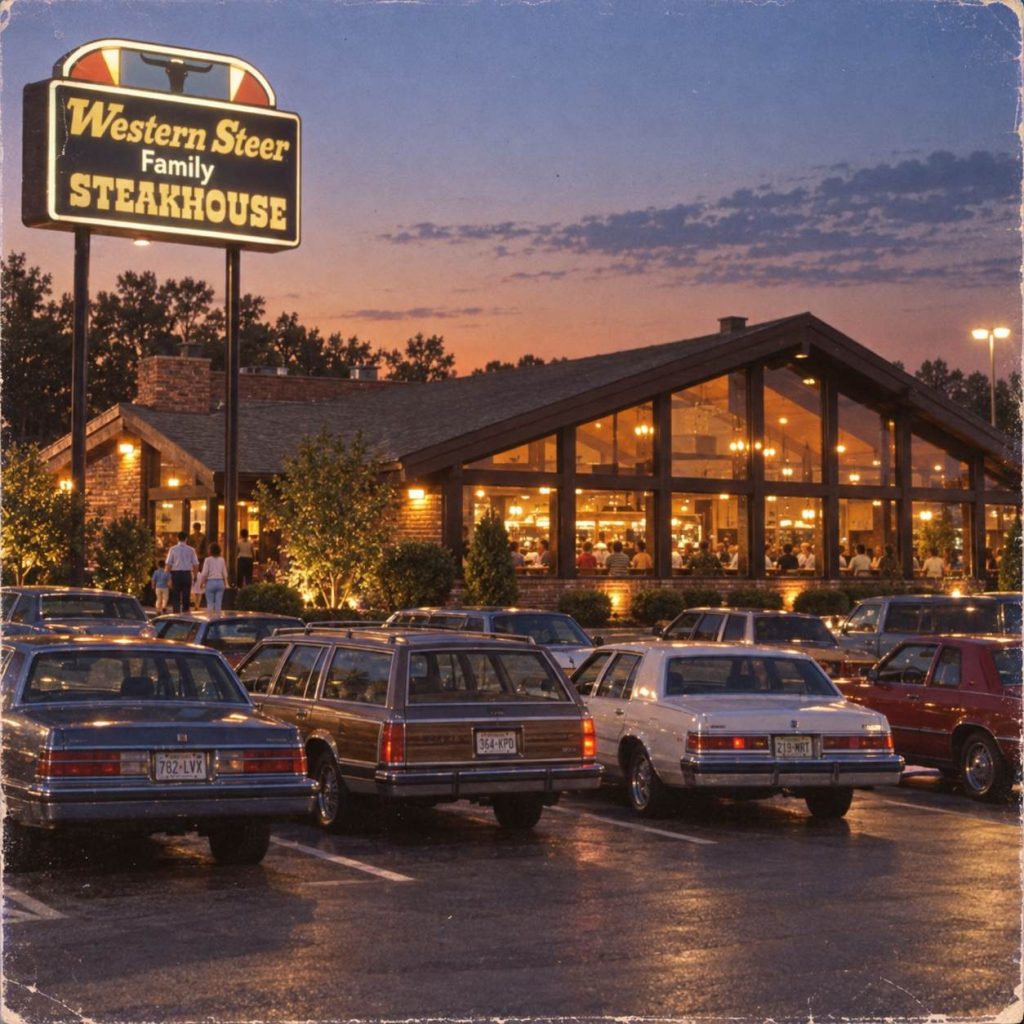
There was a particular kind of restaurant America built very well in the 1980s.
It was large. Usually brick. There might be acres of dark wood inside, enormous windows, hanging plants, upholstered chairs and enough dining-room square footage that a child could lose sight of the table on the way back from the buffet.
The restaurant was neither fancy nor especially casual. Somebody might order a steak. Somebody else might eat from the buffet. There were servers clearing plates, families celebrating birthdays and, somewhere in the middle of all of it, a food bar large enough to require its own geography.
Western Steer was one of those places.
And for a while, there were nearly 200 of them.
Today the name has almost disappeared. But during the 1980s and early 1990s, Western Steer Family Steakhouse was a substantial regional restaurant chain, concentrated largely across the Southeast, with an increasingly ambitious buffet operation that eventually became almost as important as the steaks themselves.
The more you look into Western Steer, the stranger its disappearance seems. This was not a handful of forgotten roadside restaurants. This was a real regional restaurant empire – and, increasingly, a buffet empire.
It Started With Ham
Western Steer’s ancestry did not begin with a steakhouse at all.
Charles Conner and Marshall Digh started a North Carolina food business called Mom ‘n’ Pop’s Ham House in 1966. The operation expanded into ham curing and bakery production, and in 1975 the partners opened the first Western Steer Family Steakhouse. The restaurant side grew quickly enough that Western Steer and Mom ‘n’ Pop’s eventually became parts of the same larger company.
The concept occupied familiar territory. Western Steer belonged to the generation of American family steakhouses that also produced names such as Ponderosa, Bonanza, Western Sizzlin and, later, Ryan’s. These were restaurants where steak could be affordable enough for an ordinary family dinner rather than an occasion requiring white tablecloths.
But Western Steer gradually moved in an unusually buffet-heavy direction. What began as a steakhouse with a salad bar became something considerably more ambitious.
First Came the Salad Bar
Like many steakhouse chains of its era, Western Steer began with a salad bar.
The company was serious enough about it to give the thing a name. In 1979 it began using Waltzing Matilda for its buffet salad-bar service. The title sounds almost impossibly of its time, but it gives us an early indication that Western Steer did not regard the salad bar simply as somewhere to retrieve lettuce while waiting for the steak. It was part of the attraction.
Then the attraction started getting larger.
By the middle of the 1980s, Western Steer had created something it called the All-American Food Bar.
That name first appeared commercially in 1986. This was no longer a salad bar.
The All-American Food Bar
Contemporary advertising gives us a wonderfully clear idea of what Western Steer was actually doing. One 1986 advertisement promised an All-American Food Bar with more than 80 items.
Eighty.
Not eighty salad toppings. Eighty items.
There were salads, hot vegetables, casseroles, meats, breads, cobblers and desserts. Other period promotions show the concept expanding further still. Eventually, the restaurants would add a bakery and advertise multiple separate buffet bars within the same restaurant.
For anyone who encountered one as a child, this explains why the memory can seem exaggerated. It probably isn’t. These were very large buffets.
And they were inexpensive. Company history from the period places the All-American Food Bar at roughly $3.99 by itself, or just $1.89 when added to an entree.
That second price tells us something important about how Western Steer originally understood the buffet. It wasn’t supposed to replace the steakhouse. It was supposed to accompany it.
Order your steak. Add the Food Bar. Eat your salad. Find some vegetables. Take some bread. Go back for something else. The steak could still arrive at the table while an entirely separate meal was unfolding around it.
Western Steer had created a hybrid.
These Were Proper Restaurants
The buildings mattered too.
A Western Steer did not necessarily feel like a cheap restaurant. The company exercised significant control over how its franchises were constructed, supplying operators with building blueprints, construction specifications, equipment layouts, furniture and fixture plans, interior-decor plans, sign specifications and site-planning guidance.
So those Western Steers that somehow looked recognizably like other Western Steers really were related. The chain had an architectural language: large brick structures, broad dining rooms, extensive glass, darker woods and substantial seating capacity.
Surviving former Western Steer buildings help explain the scale. At least one has been marketed at roughly 7,000 square feet, with three dining rooms, a solarium, a central bar and a working fireplace.
That is an astonishing amount of restaurant when viewed from the era of the drive-through pickup shelf. But it makes perfect sense for what Western Steer was trying to be. This was somewhere you stayed.
Then the Buffet Started Taking Over
The All-American Food Bar worked. Very well.
By 1987, it accounted for roughly 20 to 25 percent of average restaurant sales. Western Steer kept developing it.
Between 1988 and 1990, the company revamped the Food Bar, and its share of restaurant sales climbed to about 45 percent.
Think about that for a moment. Western Steer was nominally a steakhouse, but nearly half of its sales were now coming from the buffet.
At some point, the question becomes unavoidable: was this still a steakhouse with a buffet, or was it becoming a buffet that also sold steaks?
Western Steer itself did not appear entirely sure.
Nearly 200 Western Steers
The chain’s scale at the end of the 1980s is easy to underestimate now.
In October 1988, Western Steer’s parent company owned 46 restaurants outright and franchised another 140. That is 186 Western Steers across 12 states, most of them in the Southeast.
This was a serious restaurant chain. Its parent company reported $82 million in annual revenue around the same period, and management was still thinking bigger.
As late as 1990, Western Steer was considering additional restaurant development as part of an effort to strengthen regional markets and compete more broadly with national steakhouse chains.
On paper, Western Steer was still going somewhere. Underneath, however, things were becoming complicated.
The Buffet Was Popular. It Was Also Expensive.
Here we encounter a familiar buffet paradox.
People liked the Food Bar. That was not the problem.
The problem was what it cost to operate. Western Steer’s corporate history identifies high food costs as one of the major issues facing the chain as the 1980s ended. The company was simultaneously contending with heavy competition in the budget-steakhouse business and a slowing economy.
The buffet made the equation more difficult. Forty-five percent of sales flowing through a self-service food bar meant an enormous amount of purchasing, preparation, replenishment and labor.
Western Steer began trimming its menu and experimenting with alternatives, including versions of the concept that emphasized conventional table service rather than the buffet. The company was searching for what Western Steer was supposed to become.
So Naturally, It Built an Even Bigger Buffet
Then Western Steer did something wonderfully characteristic of buffet history.
Faced with the difficulty of operating a giant buffet, it made the buffet bigger.
In 1992, Western Steer began rolling out an upgraded restaurant package built around an expanded buffet and an in-store bakery. The branding eventually said everything: Western Steer – Steaks, Buffet, Bakery.
A 1993 advertisement promoted eight separate buffet bars along with the bakery.
Eight.
The price was $4.69 Monday through Friday, rising to $5.69 after 4 p.m. and on Saturdays. The advertising proudly called the whole arrangement the All-You-Can-Eat Buffet Feast.
There is something almost admirable about the lack of restraint. Other restaurant companies might have responded to difficult buffet economics with a smaller salad bar. Western Steer added a bakery.
A Steakhouse Searching for Itself
The problem was that Western Steer was no longer competing only with Ponderosa and Bonanza. The American restaurant business was changing.
During the early 1990s, the inexpensive family steakhouse was increasingly squeezed between two different kinds of restaurants. At one end were value-oriented buffet chains. At the other were newer casual-dining steakhouses and themed restaurants where table service, alcohol and atmosphere produced larger checks and better economics.
Western Steer sat awkwardly between them.
The company adjusted the buffet. It experimented with table service. It developed Prime Sirloin. It became involved with Sagebrush Steakhouse & Saloon. Meanwhile, its parent company’s bakery and prepared-food businesses were becoming increasingly important.
The broader steakhouse market was not helping. The mid-1990s were difficult years for many American steakhouse chains, and Western Steer’s parent company’s results became volatile: a loss in 1994, a profit the following year and another loss in 1996.
Western Steer was still there. But it was no longer obviously the company’s future.
How Does a Chain of Nearly 200 Restaurants Disappear?
Slowly.
There was no single afternoon when 186 Western Steers turned off their signs. The chain was heavily franchised. Of those 186 restaurants documented in 1988, 140 belonged to franchisees rather than the corporation itself.
That meant the decline did not happen on one corporate timetable. Some franchisees closed. Some left the system. Some restaurants changed names. Some continued as Western Steer long after the parent company had begun concentrating elsewhere. At the same time, the company curtailed new franchise development while trying to reposition the concept.
That distinction also explains why the later numbers can look more dramatic than they really are. When company documents refer to only 17 Western Steers in 1998, they are describing the restaurants the company itself owned, not every franchised Western Steer that may still have been operating.
But the direction was unmistakable. The large network of the late 1980s was fragmenting, and Western Steer’s own parent company increasingly had other ideas.
Enter Sagebrush
One of those ideas was Sagebrush Steakhouse & Saloon.
Sagebrush represented almost the opposite answer to the question Western Steer had been struggling with. Instead of a traditional family steakhouse increasingly dominated by a buffet, Sagebrush was a more contemporary casual steakhouse: table service, a stronger dinner orientation and the atmosphere of the 1990s restaurant boom.
The economics were not close.
By 1998, the company reported that a typical Sagebrush restaurant generated 44 percent more revenue than a typical Western Steer. Even more strikingly, it produced 99 percent more EBITDA – almost twice the operating earnings.
At that point, sentimentality was unlikely to win the argument. The company owned 17 Western Steers and five Prime Sirloins and planned to convert most of those family steakhouses to Sagebrush. Early conversions were already producing higher sales.
Western Steer’s fate had essentially been decided – not by one catastrophic failure, but by the discovery that the company had found a restaurant model it liked better.
The Company Left Restaurants Too
There is one final corporate twist.
The business that created Western Steer had begun in restaurants and built a food-processing operation largely to support them. Eventually, the food-processing business became more important than the restaurants themselves.
In 1998, WSMP changed its name to Fresh Foods, Inc. The company separated its restaurant and food-processing businesses, and in October 1999 it disposed of the restaurant segment altogether. The corporate descendant eventually became part of Pierre Foods.
So the company that once operated one of the Southeast’s largest steakhouse systems did not merely move beyond Western Steer. It eventually moved beyond restaurants.
When the Restaurant Itself Was Part of the Occasion
Western Steer belongs to a period of American dining that is becoming increasingly difficult to recreate.
It was not fine dining, and nobody needed it to be. But it was substantial. The building was large. The dining room was comfortable. Somebody came to the table. The steak arrived on a plate. The buffet might hold dozens upon dozens of choices, and eventually there was bread coming out of an actual bakery inside the restaurant.
The experience assumed that families would come inside, sit for a while and make a meal of it. The buffet was central to that promise: choice, abundance and the freedom to try something simply because it was there.
Western Steer eventually discovered that this generosity was not always an easy business model. Its parent company changed. The restaurant industry changed. Franchise locations disappeared one by one, and many company restaurants became something else.
But one remarkable artifact remains in Elkins, West Virginia. Steer Steakhouse – legally descended from Western Steer and still occupying the kind of purpose-built steakhouse property that belongs unmistakably to that era – continues to serve steaks and a buffet. It is a small living reminder of the years when America built enormous family steakhouses, filled them with food and invited everybody to stay awhile.