When All-You-Can-Eat Went Luxury
Walk into one of the newer high-end all-you-can-eat restaurants without doing any homework and the menu can look a little like a language test.
Wagyu. A5. M9. Shabu-shabu. Yakiniku. Sukiyaki. Ninety-minute seating. Three or four dining tiers.
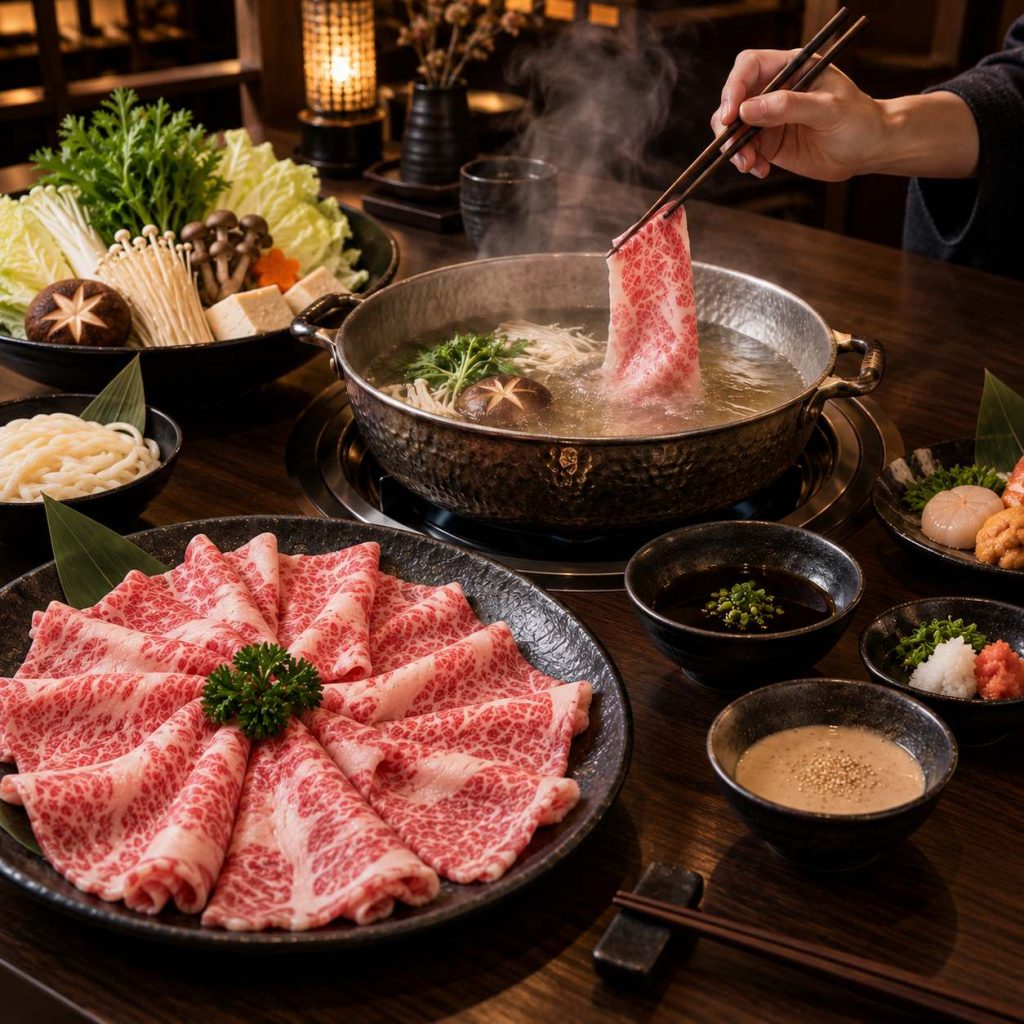
A server arrives carrying trays of beef sliced so thinly that the marbling looks almost drawn onto it. There may be a simmering pot built into the table, or a smokeless grill. Somewhere nearby is a sauce station, a vegetable bar, seafood, sushi and perhaps an ice cream machine. At the more extravagant end, there may also be uni, caviar, lobster, foie gras or Wagyu nigiri finished with a torch.
It is all-you-can-eat dining.
But it does not look very much like the buffet many Americans grew up with.
That is because a new upper end of AYCE dining is taking shape in the United States. It borrows from Japanese shabu-shabu and yakiniku, overlaps with Chinese hot pot and Korean barbecue, and increasingly builds the entire experience around one ingredient that carries unusual cultural and economic weight: Wagyu beef.
The result is a restaurant category that is expanding quickly enough to be noticeable, but is still new enough that a surprising number of people are not entirely sure what they are walking into.
First, A Small Vocabulary Lesson
The easiest way to understand these restaurants is to separate three words that are frequently placed together but do not mean the same thing.
Shabu-shabu is a Japanese hot-pot style. Yakiniku is Japanese tabletop grilling. Wagyu is beef.
Once those three things are clear, most of the menu begins to make sense.
It also helps to clear up one common American shortcut: these restaurants are not simply another version of Korean hot pot.
East Asian tabletop cooking traditions overlap, influence one another and are increasingly mixed together by modern American restaurant groups. But Chinese hot pot, Japanese shabu-shabu, Korean barbecue and Japanese yakiniku are not interchangeable names for the same meal.
Shabu-Shabu: The Quiet One
Shabu-shabu is Japanese, and its modern restaurant form dates to postwar Osaka. Suehiro, the restaurant credited with developing and naming the dish, traces it to the early 1950s and acknowledges inspiration from a Chinese mutton hot-pot tradition.
The cooking itself is almost startlingly simple.
A pot of broth sits in the middle of the table. Very thin slices of meat are picked up with chopsticks and moved briefly through the hot liquid – the swishing motion that gave shabu-shabu its name. Vegetables, tofu, mushrooms and noodles cook in the same pot. The meat is generally eaten with dipping sauces rather than buried under a heavy marinade.
That restraint becomes important when the beef is expensive. Highly marbled Wagyu does not need much help. A few moments in hot broth soften the fat and warm the meat without turning an expensive slice into stew.
In a traditional shabu-shabu restaurant, the pleasure is partly in the repetition: swish, dip, eat, repeat. In an AYCE version, the server simply keeps bringing meat until the time is up or the table is finished.
Yakiniku: Same Table, Completely Different Dinner
Yakiniku moves the action from broth to fire.
The word is Japanese and literally refers to grilled meat. In the restaurant format familiar today, small cuts of beef, pork, seafood and vegetables are cooked on a grill built directly into the table. Modern yakiniku developed in Japan with deep Korean influence, which is why it can look familiar to anyone who has eaten Korean barbecue.
They are close relatives, but the dining languages are different. Korean barbecue commonly surrounds grilled meat with banchan, lettuce wraps, Korean marinades and a distinctly Korean meal structure. Yakiniku tends to focus tightly on individual cuts of meat, Japanese-style dipping sauces and a sequence of smaller pieces cooked quickly over intense heat.
For an American diner, the easiest distinction is practical.
Shabu-shabu: you cook the meat in broth.
Yakiniku: you cook the meat on a grill.
Some of the newest Wagyu restaurants offer both under the same roof.
And Wagyu Is Not a Cooking Method
Wagyu may be the most misunderstood word on the menu.
It does not mean shabu-shabu. It does not mean yakiniku. It does not automatically mean Japanese A5.
Wagyu refers to Japanese cattle genetics and, in restaurant usage, now covers several different beef categories. Imported Japanese Wagyu sits at the top of the hierarchy. The famous A5 designation belongs to Japan’s grading system, with the letter describing yield and the number representing the highest level of meat quality within that system.
Australian Wagyu uses a different grading structure and is often identified by marbling scores such as M8 or M9. American Wagyu frequently refers to cattle with Japanese Wagyu genetics crossed with domestic breeds such as Angus.
That distinction explains something that can otherwise seem impossible.
A restaurant can advertise all-you-can-eat Wagyu for a price that would be financially absurd if every slice were imported Japanese A5 ribeye.
The lower tiers may center on American Wagyu chuck, brisket or shoulder. Move upward and Australian Wagyu appears. At the highest levels, Japanese A5 becomes part of the experience – sometimes without limits, sometimes as a more controlled premium selection.
The word Wagyu is therefore the beginning of the question, not the end of it.
How the Meal Usually Works
The modern luxury AYCE version is surprisingly structured.
First, the table chooses a dining tier. The price of that tier determines which meats and premium items are available. A lower level might include several cuts of American Wagyu and pork. The next level may add Australian Wagyu. The top tier may unlock Japanese A5, premium seafood and specialty dishes.
Then the table chooses how it wants to cook.
At a shabu-shabu restaurant, that usually means selecting one or two broths. Sukiyaki – a sweeter soy-based Japanese preparation – often appears alongside traditional shabu broth, spicy miso, tonkotsu or newer fusion options.
At a yakiniku restaurant, the grill is already waiting in the table.
Meat usually comes from the kitchen in relatively small orders. That is deliberate. Rather than covering the table with twenty plates at once, diners order another round when they are ready. At some restaurants a server may cook especially valuable cuts, but much of the appeal is doing the cooking yourself.
Vegetables, noodles, rice, sauces, condiments and desserts often live on a self-service bar. This is the part that feels most recognizably buffet-like. The expensive proteins, meanwhile, are controlled through table service.
Most restaurants also operate on a clock. Ninety minutes is common. Two hours is common at more elaborate concepts. Food-waste rules are equally common.
This is abundance, but highly engineered abundance.
Why Does All-You-Can-Eat Suddenly Cost This Much?
For decades, American buffet pricing trained us to associate all-you-can-eat with a bargain.
These restaurants ask us to reverse that logic.
The proposition is not simply, ‘How much food can I get?’ It is increasingly, ‘How many expensive things can I experience for one fixed price?’
That changes the check dramatically.
The more accessible Wagyu AYCE restaurants often begin somewhere around the price of a nicer casual dinner. Premium tiers commonly move into the $50 to $100 range. Once genuine Japanese A5, luxury seafood, uni, caviar or elaborate tableside service enter the picture, three-digit per-person pricing is no longer unusual. At the most extravagant end, the meal can push well beyond $100 and into the territory Americans traditionally associate with steakhouses and tasting menus.
What makes the model work is that the restaurant controls the abundance much more carefully than an old-fashioned steam-table buffet.
There is a time limit. Premium ingredients are tiered. Meat arrives in small portions. Some especially costly items may be limited even when the rest of the menu is unlimited. Richly marbled beef is also difficult to consume in conventional steakhouse quantities; a few ounces of A5 can feel more substantial than its size suggests.
And while the customer receives a luxury product, the customer is also doing part of the cooking.
It is a clever trade: the restaurant provides increasingly expensive raw materials, while the table provides much of the final heat.
The American Road to Luxury AYCE
None of the individual ideas arrived in America yesterday.
Japanese tabletop grilling had already gained a national foothold by the early 2000s. Gyu-Kaku opened its first U.S. restaurant in West Los Angeles in 2001 and helped teach American diners the basic ritual of Japanese yakiniku: order small plates of raw meat, grill them yourself and make dinner a social activity.
All-you-can-eat shabu-shabu had an established history in Japan as well. Mo-Mo-Paradise began in Tokyo in 1993 and brought its Japanese AYCE shabu and sukiyaki model to the United States in Rowland Heights, California, in 2016.
That same year, another important piece appeared in Las Vegas.
Chubby Cattle opened in Chinatown with individual hot pots and a refrigerated conveyor belt carrying ingredients past the table. The original concept leaned Chinese and Mongolian rather than Japanese, but it established something that would become extremely important to the next generation of AYCE restaurants: tabletop cooking could be immersive, technological, visually dramatic and designed as entertainment.
Then came the luxury turn.
In 2020, The X Pot opened at the Palazzo in Las Vegas. This was hot pot recast as a destination restaurant, with A5 Wagyu, high-end seafood, robot servers, projections and theatrical dining-room effects. The underlying act – cooking food in a pot at the table – was familiar. The presentation was not.
The pandemic slowed restaurant expansion everywhere, but it did not stop the idea.
In 2021, Japanese restaurant giant Skylark opened the first U.S. Shabu-Yo in the Chicago area, bringing another established Japanese all-you-can-eat shabu brand into the market.
In late 2022, Niku X arrived in downtown Los Angeles as a high-end yakiniku restaurant built around premium Wagyu. It initially operated more like a tasting-menu steakhouse than a buffet, but later moved into an ultra-premium AYCE format – a telling sign of where the economics and customer interest were heading.
Then the pace accelerated.
The Chubby Group Effect
If there is one company that makes this new category easier to see, it is Chubby Group, the restaurant company that grew out of Chubby Cattle.
Rather than building one national chain, the group has built a family of related concepts at different price points and with different cooking systems.
The X Pot pushes hot pot toward immersive luxury. Niku X pushes Japanese grilling toward steakhouse and tasting-menu territory. Mikiya Wagyu Shabu House centers the experience on tiered all-you-can-eat Wagyu shabu-shabu. Wagyu House combines shabu-shabu and yakiniku. Wagyu Factory aims at a more accessible Wagyu hot-pot-and-barbecue experience. Chubby Cattle itself has expanded into Wagyu-focused hot pot and BBQ formats.
Mikiya may be the clearest example of how quickly the idea is traveling.
Its first restaurant appeared in Temple City, California, in 2023. Within a short period the brand had moved beyond Southern California into markets including Las Vegas, Northern California, Hawaii, Texas, Boston and New York.
That is an unusually fast geographic jump for a dining format that still requires many customers to be taught what shabu-shabu means.
The group is also increasingly involved in its own Wagyu sourcing and supply chain. That matters because the entire luxury-AYCE proposition depends on obtaining premium beef consistently enough – and at sufficiently predictable cost – to sell it without counting every slice individually.
The Other Names to Know
Chubby Group is not the entire category.
Mo-Mo-Paradise remains important because it represents the more traditional Japanese AYCE shabu model: a pot, carefully sliced meats, vegetables, sauces and a fixed period of unlimited ordering without the need for spectacle.
Shabu-Yo matters for a different reason. Its parent, Skylark, operates thousands of restaurants in Asia. If Japanese-style shabu continues to translate successfully to the United States, Shabu-Yo has the infrastructure of a very large restaurant company behind it.
Gyu-Kaku remains one of the most familiar Japanese yakiniku names in America and helped normalize tabletop grilling long before Wagyu became the star of the current luxury wave.
Around all of them is a rapidly multiplying field of regional shabu, hot-pot and Japanese barbecue restaurants. Some are value-driven. Some are premium. Some mix Japanese, Korean and Chinese ideas freely enough that traditional category lines become blurry.
That blur is part of why the trend can be difficult to recognize. There is no single sign that says ‘Luxury AYCE 2.0.’ The restaurants may call themselves shabu houses, Wagyu houses, Japanese BBQ, hot pot, yakiniku or steak experiences.
But the economic proposition underneath them is increasingly similar.
How Extravagant Can This Get?
Very.
The upper end no longer stops at better slices of beef.
Current luxury menus can combine Japanese A5 Wagyu with live or premium seafood, lobster, king crab, oysters, uni, caviar, foie gras, bone marrow, Wagyu tartare, sashimi and Wagyu nigiri.
Some restaurants torch the surface of Wagyu sushi. Others grill premium cuts tableside for the guest. Niku X has offered large Wagyu steaks finished with elaborate tableside flame. The X Pot has pushed the experience toward immersive Las Vegas spectacle while keeping unlimited dining at its center.
This is where the category becomes genuinely new.
The traditional American buffet placed luxury at the edge of the format. Maybe there was prime rib on Saturday night. Maybe crab legs cost extra.
These restaurants are beginning with the expensive ingredient and building the all-you-can-eat proposition around it.
All-You-Can-Eat Is Learning a New Language
For American diners, this upper tier of AYCE can require a little translation.
Shabu-shabu is not simply hot pot with a Japanese name. Yakiniku is not simply Korean barbecue with Japanese signage. Wagyu is not a synonym for A5. And a $90 all-you-can-eat menu is not trying to compete with the neighborhood buffet that charges a fraction of that.
It is a different proposition.
The old promise of AYCE was quantity at a fixed price. This new version adds access: access to unfamiliar cooking styles, different grades of Wagyu, expensive seafood and ingredients that many customers might otherwise hesitate to order a la carte.
That makes the experience surprisingly consistent with what buffets have always done well.
They let people explore.
The setting has changed. The steam table may have become a simmering pot. The carving station may have become Japanese A5 arriving on a small ceramic plate. The price may now resemble a steakhouse dinner.
But the basic invitation is still recognizable: choose what interests you, try something new, and if you liked it, have another.
The newest generation of all-you-can-eat restaurants is discovering that abundance does not have to mean inexpensive food.
Apparently, it can also mean Wagyu.