Let us begin with the question that has probably been argued over at more Chinese buffet tables than anyone would care to admit.
How do you pronounce Tso?
In the American name of the dish, Tso is generally pronounced SOH. General Tso’s sounds like “General So’s.”
The actual nineteenth-century Chinese general’s surname is written Zuo in modern pinyin, so the Mandarin pronunciation is different. The spelling “Tso” comes from an older system of romanizing Chinese names.
Which is already more history than most of us expected to encounter before getting to the chicken.
There Really Was a General Tso
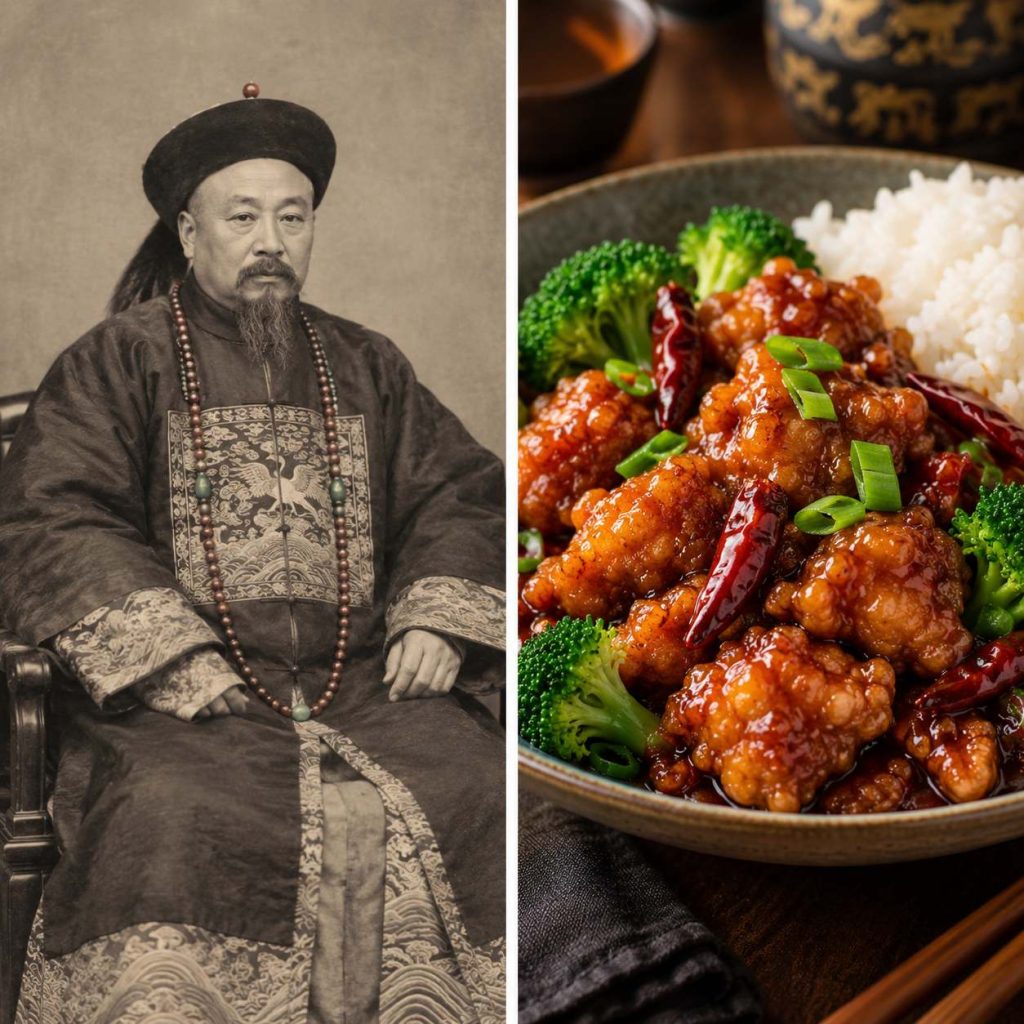
His actual name was Zuo Zongtang, historically romanized in the West as Tso Tsung-t’ang. He was born in Hunan in 1812 and became one of the Qing dynasty’s important nineteenth-century military commanders and statesmen.
He fought in major campaigns during the Taiping Rebellion, later commanded forces in northwest China and became associated with efforts to strengthen and modernize the Qing state.
He died in 1885.
He had absolutely nothing to do with the chicken.
There is no evidence that he invented it, requested it, endorsed it or sat down after a military campaign and asked somebody to bring out the sticky red dish.
In fact, he had been dead for roughly 70 years when the dish carrying his name appeared.
So Who Invented General Tso’s Chicken?
The chef most widely credited with creating the original dish was Peng Chang-kuei, a prominent Hunanese cook who had worked for the Chinese Nationalist government.
After the Communist victory in China in 1949, Peng fled to Taiwan with the Nationalist government. In Taipei during the early 1950s, he developed the dish that would become General Tso’s chicken.
Peng later connected its creation to a 1953 diplomatic banquet held for visiting U.S. Admiral Arthur Radford. Needing another dish for the meal, Peng devised a chicken preparation with the hot, sour and savory character of Hunanese cooking.
Then he gave it a grand name.
General Tso’s Chicken.
Why General Tso? Peng and Zuo were both from Hunan, and Peng later explained that he wanted to honor a famous Hunanese figure whose bold character suited the dish.
So this was not the general’s recipe.
It was a Hunanese chef naming a new creation after an imposing Hunanese general.
Which, when you think about it, is a considerably better story anyway.
But the Original Was Not Quite Our General Tso’s
If Peng’s original version suddenly appeared on the average American buffet today, some diners might wonder where General Tso’s chicken had gone.
Peng described his version as fundamentally Hunanese: hot, sour, salty and savory. It was not the extremely sweet, heavily battered, dark glossy chicken that Americans now recognize immediately.
The American transformation happened in New York.
During the early 1970s, chefs were bringing Hunanese and Sichuan cooking into a city increasingly curious about regional Chinese food. Peng himself opened a Manhattan restaurant in 1973, near the United Nations, and attracted diplomats and prominent customers.
But another New York chef, Tsung Ting “T.T.” Wang, had already encountered versions of Peng’s cooking in Taiwan and began serving his own interpretation.
The changes were enormously consequential.
Crispier batter.
More sugar.
There it is.
The General Tso’s chicken most Americans know begins to appear.
America Was Ready for It
The timing could hardly have been better.
President Richard Nixon visited China in 1972, putting Chinese food, banquets and regional cooking into American living rooms at precisely the moment New York restaurants were introducing diners to Hunanese and Sichuan flavors.
General Tso’s chicken offered just enough adventure without asking very much of the diner.
Fried chicken.
Sweet sauce.
A little heat.
A mysterious Chinese general.
That is an excellent restaurant product.
Then the 1990s Buffet Boom Happened
General Tso’s chicken was gaining a following in New York during the 1970s, but the version many buffet diners remember as practically universal arrived later.
And if your memory says the dish seemed to become especially common during the 1990s, your memory is doing a surprisingly good job.
General Tso’s remained strongly associated with New York and the East Coast until the 1990s, when Fujianese immigrants became increasingly important in the Chinese restaurant business across the eastern United States.
Many opened Chinese buffets.
And General Tso’s chicken became one of their dependable staples.
That dovetailed perfectly with the broader Chinese-buffet boom of the decade. Across the country, buffet lines filled with fried rice, egg rolls, beef with broccoli, lo mein and proteins coated in glossy sauces.
General Tso’s was almost suspiciously well suited to the format.
It May as Well Have Been Designed for a Buffet
Consider what a buffet operator gets.
The chicken is boneless and already bite-sized. It portions easily with a serving spoon. Dark meat can stay reasonably juicy. The sauce has enough flavor to remain satisfying beside rice. There are no shells, bones or complicated eating instructions.
And critically, people know its name.
Buffets encourage experimentation, but they also need safe harbors.
You may take one spoonful of something unfamiliar.
Then you put some General Tso’s chicken beside it because you already know what that is going to do.
By the 1990s, the dish had become exactly that kind of buffet anchor.
Why Does It Taste So Ridiculously Good?
The modern American version is built around contrasts that are extremely difficult to resist.
First comes the chicken, usually boneless pieces coated with starch or batter and fried until crisp.
Then comes the sauce.
Recipes vary, but the basic architecture is remarkably consistent: sugar or another sweetener for sweetness; vinegar for tartness; soy sauce for salt and umami; garlic and ginger for aroma; dried chiles or chili sauce for heat; and often hoisin or oyster sauce for another layer of savory sweetness.
Cornstarch usually appears twice in the story.
It helps produce the crisp coating on the chicken, and in the sauce it turns a collection of liquids into that glossy glaze that actually clings to the crust.
So one bite can deliver a fairly ridiculous sequence:
Crunch.
Sticky glaze.
Sweetness.
Vinegar tang.
Salt.
Garlic and ginger.
Then just enough chile warmth to suggest that General Tso has not completely surrendered.
And for a brief, glorious window after a fresh pan reaches the buffet, the chicken manages to be both crispy and covered in sauce.
Eventually the crust softens. Anyone who has returned to the same buffet pan 20 minutes later understands this part of the science.
But catch a fresh batch and the whole thing makes almost unreasonable sense.
Even the Broccoli Is Part of the American Story
The familiar presentation usually includes bright green broccoli, which turns out to be another American development.
Peng’s original dish did not depend on the broccoli-and-sticky-chicken combination familiar from takeout menus and buffet pans. Early descriptions of his version point instead toward garlic, red peppers and Chinese vegetables.
The American version eventually acquired its own visual language: dark glossy chicken, red chile, green broccoli and white rice.
It became instantly recognizable.
The Perfectly Chinese-American Chicken
Perhaps the best part of the story is that General Tso’s chicken was once largely unknown to people in China.
A Taiwanese researcher working with the Smithsonian’s National Museum of American History once wrote about being surprised to discover how important the dish was to Americans. She had grown up in Taiwan and had never eaten it.
That does not make General Tso’s chicken fake Chinese food.
It makes it Chinese-American food in an almost wonderfully concentrated form.
A Hunanese chef fleeing mainland China develops a dish in Taiwan, possibly for an American admiral, names it after a nineteenth-century Hunanese general, carries it to New York, watches other immigrant chefs crisp it and sweeten it for American diners, and then sees another generation of Chinese restaurateurs spread it through takeout shops and buffets across the country.
You could hardly invent a more Chinese-American biography for a plate of chicken.
And General Tso Never Tasted It
That may be the only fact you really need to remember the next time you see the pan.
General Tso never tasted General Tso’s chicken.
But somewhere along the way, millions of Americans did.