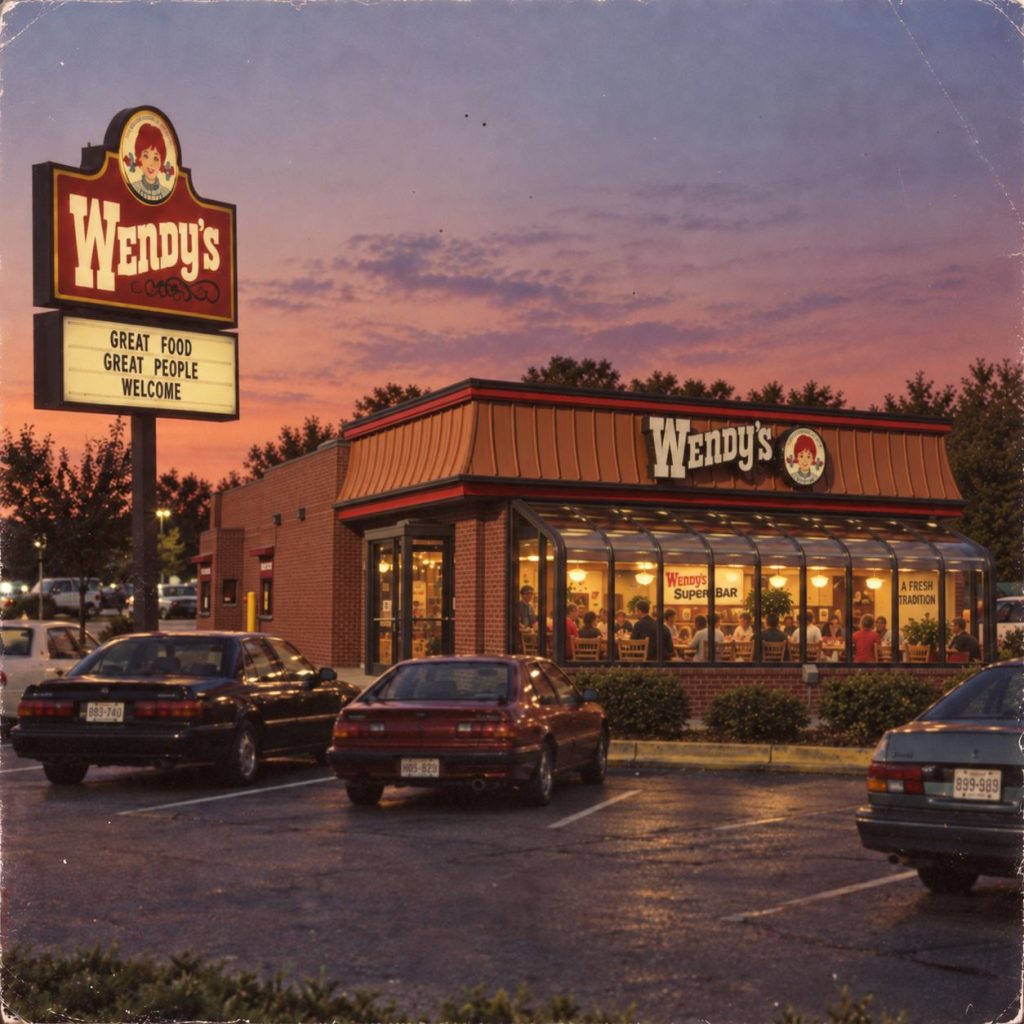
Walk into a Wendy’s today and imagine finding, somewhere between the ordering counter and the dining room, an all-you-can-eat buffet.
Not a promotional buffet. Not a salad bar with a few extra toppings. An actual buffet.
There is pasta with red sauce and Alfredo. Taco meat, refried beans, cheese and tortillas. A full salad bar. Fruit. Garlic bread. Pudding. You pay a few dollars, take a plate and come back as many times as you please.
This sounds less like something Wendy’s once operated and more like the premise of a particularly convincing piece of internet misinformation.
But it happened.
For roughly a decade, Wendy’s operated one of the more curious experiments in American fast-food history: the Wendy’s SuperBar, an all-you-can-eat buffet that took the company’s already successful salad bar and expanded it into something much closer to a miniature family-restaurant buffet.
And the strangest part of the story may be that the idea actually worked.
Wendy’s Was Already Halfway There
The SuperBar makes much more sense when viewed through the Wendy’s of the late 1970s and early 1980s.
Modern fast food is heavily oriented toward portability. The building is often simply the place where the food is produced before it leaves through a drive-through window or delivery bag.
Wendy’s of that era was different.
In November 1979, Wendy’s introduced a salad bar. The company today describes itself as the first national quick-service chain to do so. Four years later, in 1983, Wendy’s added baked potatoes to its menu. Both ideas pushed Wendy’s beyond the standard hamburger-fries-soft drink formula and gave customers considerably more freedom to assemble meals themselves.
Then Wendy’s took the next logical, or perhaps wonderfully illogical, step.
The company’s trademark filing for SUPERBAR lists May 20, 1987 as its first use in commerce. The concept received a broader rollout in 1988, which is why 1988 is usually remembered as the SuperBar’s debut year. Even its official trademark is a small bit of history: Wendy’s styled the name as one word, SuperBar, although “Super Bar” was also identified in the trademark record and has remained a common spelling ever since.
What Wendy’s had done was turn the familiar salad bar into something much more ambitious.
Welcome to Pasta Pasta, Mexican Fiesta and the Garden Spot
The classic SuperBar was essentially divided into three worlds.
The Garden Spot was the descendant of Wendy’s existing salad bar. There were greens, vegetables, toppings, prepared salads, fruit and desserts. Among the most frequently remembered items are the tubs of pudding that seemed almost obligatory on salad bars of the period.
Then things became considerably less conventional.
Pasta Pasta offered Italian-American comfort food: noodles, tomato-based sauces, creamy Alfredo-style sauce and garlic bread. One charming detail has survived particularly well in the collective memory of former customers: the garlic bread was made from Wendy’s hamburger buns, transformed with butter and garlic into something entirely different from their normal job supporting a Single or a Double.
Beside it was Mexican Fiesta, essentially a build-your-own taco and nacho operation. Taco meat, beans, rice, cheese, tortillas, chips, sour cream and other toppings allowed customers to construct tacos, burritos, nachos or whatever combination happened to make sense at the moment.
And because many ingredients were shared between sections, the distinctions quickly became suggestions rather than rules.
That, of course, is one of the pleasures of a buffet.
Pasta can end up beside a taco. Taco cheese can end up on a salad. Salad toppings can migrate onto nachos. Chocolate pudding can appear on a plate whose previous occupants are best left unmentioned.
The SuperBar gave customers permission to improvise.
It was, in its own small way, an edible free-for-all.
And Yes, It Really Was That Cheap
Perhaps nothing makes the SuperBar seem more distant than its price.
The number most associated with it is $2.99.
Prices varied by market, promotion and meal period, but $2.99 was a widely advertised price for the all-you-can-eat experience. Contemporary memories and later accounts also show somewhat higher dinner prices and prices rising as the years passed.
Even accounting for inflation, the psychology of the proposition was extraordinary.
Walk into Wendy’s. Pay roughly the cost of a normal fast-food meal. Eat pasta. Make a taco. Build a salad. Go back for more. Finish with pudding.
There was no need to decide whether tonight was an Italian night, a Mexican night or a salad night.
Wendy’s had thoughtfully resolved the matter.
Tonight could apparently be all three.
The SuperBar Wasn’t a Failure
This is the part of the story that tends to get lost.
Old discontinued fast-food products are usually remembered as failures. Something appeared, customers shrugged, corporate headquarters quietly removed it and everyone moved along.
The SuperBar does not fit that story very well.
In November 1988, the Los Angeles Times reported that Wendy’s third-quarter net income had risen 74 percent from the previous year. Wendy’s attributed the improvement partly to lower food costs and partly to the introduction of the SuperBar.
Even more revealing was another number: the company said the SuperBar was averaging more than 20 percent of restaurant sales.
One-fifth of sales.
For an all-you-can-eat buffet operating inside a national hamburger chain.
People were not simply tolerating this peculiar new addition to Wendy’s.
They were using it.
A lot.
Wendy’s Was Briefly Becoming Something Else
There is an important cultural difference between a fast-food restaurant with a buffet and one without it.
A buffet asks you to stay.
You get a plate. You sit down. You eat. You decide whether you would like something else. You stand up again. You wander back to the food. Someone else at the table does the same.
Time passes.
That is fundamentally different from ordering a burger designed to be handed through a window.
Dave Thomas understood that distinction. In a 1988 advertisement for the SuperBar, he talked about liking the idea of families eating together. A Wendy’s executive later described the concept as effectively taking the company out of the fast-food business.
That statement gets remarkably close to the central tension of the whole experiment.
The SuperBar was turning Wendy’s into something between a hamburger chain and a family restaurant.
For customers, that could be a feature.
Operationally, it was considerably more complicated.
Even Golden Corral Was Paying Attention
Here is one of the better footnotes in fast-food buffet history.
In May 1988, Golden Corral Corporation formally opposed Wendy’s application to register the SUPERBAR trademark.
Yes, Golden Corral.
The company whose identity would eventually become almost synonymous with the American buffet found itself in a trademark proceeding opposite Wendy’s over the name of Wendy’s buffet.
The proceeding continued into 1989 before being dismissed without prejudice that September. The surviving trademark record establishes the dispute, although it would be unwise to invent motives beyond what the filings document.
Still, the episode tells us something.
The Wendy’s SuperBar was not some obscure regional oddity operating unnoticed in a corner of the chain.
People in the buffet business knew it was there.
For One Future Chef, It Mattered Quite a Lot
Perhaps the warmest surviving SuperBar story belongs to chef Travis Milton.
Milton grew up in rural Virginia and has written about becoming fascinated as a child by fettuccine Alfredo after seeing the dish prepared on television. It seemed exotic and largely inaccessible where he lived.
Then someone told his family that he could try it somewhere nearby.
At Wendy’s.
His mother took him to the SuperBar.
Milton later wrote for Food & Wine about tasting that Wendy’s Alfredo and wandering through the rest of the buffet. It was hardly classical Italian cooking, but that was beside the point. The experience helped open a larger world of food to him and became one of the memories he connects to his eventual career as a chef.
There is something rather wonderful about that.
A child did not need a reservation, a plane ticket or an expensive restaurant to encounter a food he had only seen on television.
He needed a few dollars and a Wendy’s.
Buffets have always been good at that.
They let people sample things.
They lower the stakes of curiosity.
If you do not like something, there is another pan three feet away.
So Why Did Wendy’s Get Rid of It?
The SuperBar’s popularity created a paradox.
The concept worked with customers.
It worked much less naturally with the machinery of fast food.
A buffet requires replenishment. It requires cleaning. Hot food has to remain hot, cold food cold, serving areas orderly and ingredients available. Customers do not arrive in predictable portion sizes. Some take very little. Some return several times. Food sits on the line. Food gets mixed together. Food gets wasted.
And all of this was happening while the same Wendy’s restaurant was also expected to operate as a Wendy’s: taking counter orders, preparing hamburgers and fries and serving an increasingly important takeout and drive-through business.
The Christian Science Monitor later identified precisely that conflict as the SuperBar’s major weakness: keeping the buffet stocked and clean while simultaneously running the conventional Wendy’s operation was difficult.
Meanwhile, Wendy’s was beginning to solve the same customer needs in a much more fast-food-friendly way.
In March 1992 the company introduced Fresh-Made Salads To-Go, explicitly describing them today as an outgrowth of its successful salad-bar business. The customer still received the salad. Wendy’s simply regained control of the portion, packaging and transaction, and the meal could leave the building.
That transition tells much of the story.
The future belonged to food that traveled.
The SuperBar wanted you to get another plate.
It Did Not Vanish Everywhere at Once
The end was a phaseout rather than a single dramatic national closing.
The SuperBar is generally considered to have disappeared from Wendy’s by 1998, roughly a decade after its broad introduction.
That helps explain why memories of its final years vary so much. One Wendy’s might still have offered something resembling the old buffet while another had already moved on. The underlying salad-bar program also survived beyond the SuperBar itself; Wendy’s current corporate history says its traditional salad bars were eventually phased out in 2006 as restaurants pursued greater operational efficiency and customers increasingly wanted portable salads.
There was also a physical dimension to the disappearance.
A sandwich can vanish from a menu board overnight.
A buffet occupies a room.
Once Wendy’s no longer intended to operate the SuperBar, those large self-service fixtures represented dining-room space that had to be maintained, repurposed or eventually removed as restaurants changed.
That may be one reason the SuperBar now feels strangely ephemeral. Something once substantial enough to occupy a large part of thousands of childhood memories has left remarkably little physical evidence behind.
Mostly there are photographs.
Old advertisements.
Commercials.
A few menus and promotional pieces.
And people who still remember exactly where the pasta was.
When Fast Food Made Room for Abundance
It would be easy to treat the Wendy’s SuperBar purely as kitsch.
There is plenty to enjoy.
The names alone deserve preservation: Pasta Pasta. Mexican Fiesta. Garden Spot.
There is something endearingly unrestrained about putting Alfredo sauce, taco meat, lettuce, garlic bread and chocolate pudding within a few steps of one another and trusting America to sort out the details.
But there is another reason the SuperBar remains so interesting.
For a while, it represented a perfectly ordinary idea about eating.
You could walk into a fast-food restaurant with your family, sit down together and have choices. You could try something unfamiliar. A child could build a taco. Somebody else could have pasta. Another person could make a salad. You could go back for a little more.
Nobody had to order exactly the same thing.
Nobody had to calculate whether another spoonful of something was worth another few dollars.
The promise was simple: there is plenty. Have what you like.
That idea has always been at the heart of all-you-can-eat culture.
Sometimes abundance is treated as excess, and certainly the buffet has always carried opportunities for excess. But abundance can also mean generosity. Choice. Experimentation. A table where very different appetites can coexist.
For about a decade, remarkably, one of the biggest hamburger chains in America built that idea directly into its restaurants.
Then the restaurants changed.
The SuperBars were removed. The pasta pans disappeared. Mexican Fiesta closed for good. The old Wendy’s dining rooms gradually gave way to newer versions of what a fast-food restaurant was supposed to be.
But people remember.
And perhaps that is the most interesting thing about the Wendy’s SuperBar.
It was not beloved because it was sophisticated.
It was beloved because, for a few dollars, it made an ordinary trip to Wendy’s feel just a little abundant.
For a while, America apparently thought that was a perfectly reasonable thing for a hamburger restaurant to do.