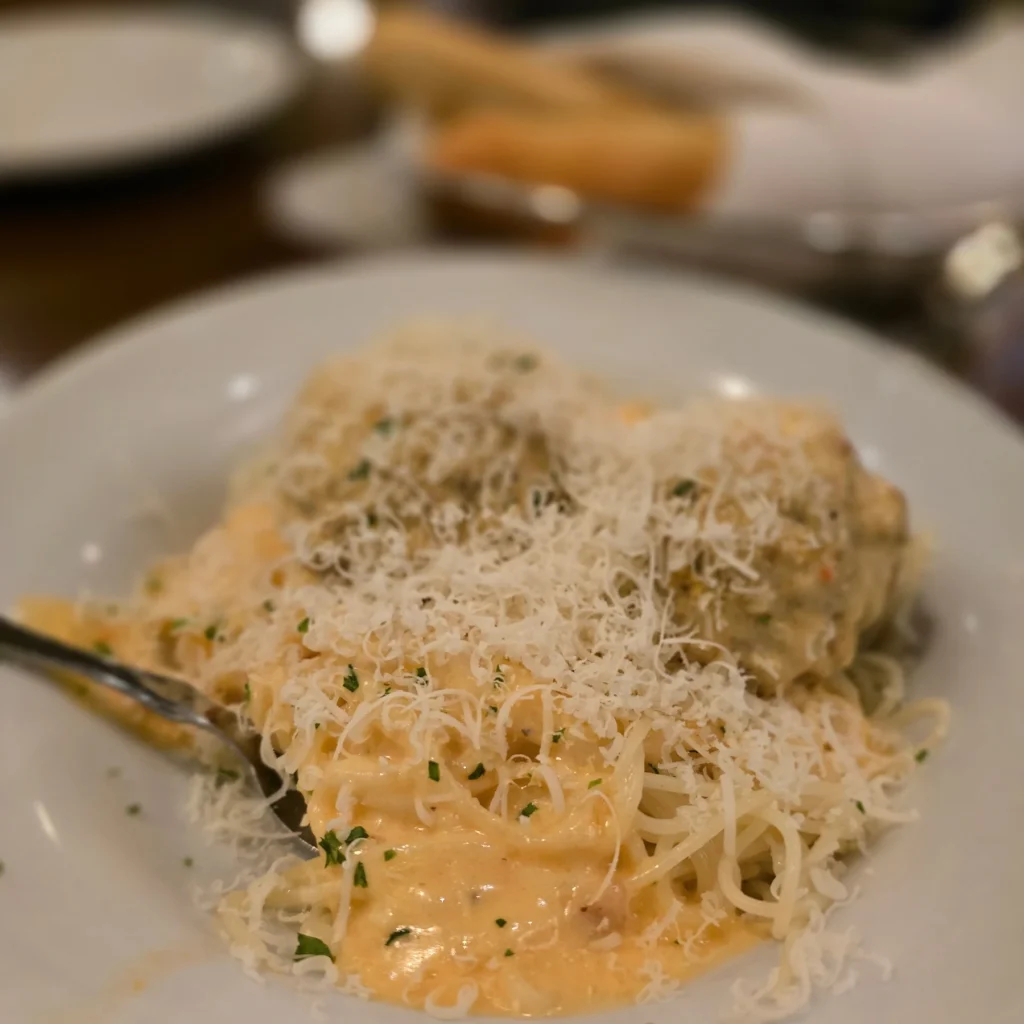
The Bowl Is Back in Full Swing
There is a particular moment in a Never-Ending Pasta Bowl meal when dinner stops being an ordinary restaurant order. The first bowl was dinner. The second might still be dinner. By the third, the question is no longer what you need. It is what you are curious enough to try next.
That small shift – from hunger to possibility – has always been the real trick behind Olive Garden’s most durable promotion. Never-Ending Pasta Bowl is not simply a large serving of pasta. It turns a familiar full-service restaurant meal into a sequence: another shape, another sauce, another topping, another pass through the menu because, for once, choosing one thing does not close the door on the others.
In 2026, that ritual is in full swing again. The public promotion runs from August 31 through November 22, starting at $14.99, with four standard pasta shapes, six sauces and four protein add-ons. Spicy Alfredo is the new sauce this year, and Crispy Shrimp Fritta has returned to the protein lineup. Olive Garden advertises 120 possible combinations before even considering the gluten-free rotini available by request.
The promotion is also carrying something it has not had since before the pandemic: the Pasta Pass. Olive Garden offered 10,000 of the $100 passes this year, good from August 24 through November 22 and including the protein toppings. According to parent company Darden Restaurants, roughly 3 million devices logged in for the sale. All 10,000 passes disappeared immediately.
That would be an impressive response to a new idea. Never-Ending Pasta Bowl is not a new idea. It is 31 years old.
It Started at $6.95
Olive Garden introduced Never-Ending Pasta Bowl in September 1995. The price was $6.95.
That number is worth lingering over. Adjusted broadly for inflation, $6.95 in 1995 is roughly $15 in 2026 dollars. The current Bowl begins at $14.99. Restaurant economics, ingredient costs and the promotion itself have changed enormously in three decades, so the comparison is not exact. But as a piece of consumer memory, it is striking: the headline value proposition has landed remarkably close to where it began in real-dollar terms.
The early Bowl was also more plainly a seasonal promotion. Surviving advertisements show the $6.95 price holding into the late 1990s, and by the mid-2000s Olive Garden was still treating the event as a compact late-summer run. In 2006, for example, it arrived in August for seven weeks. The restaurant’s annual wrinkle was often a new sauce or two rather than an entirely new structure.
That became part of the formula. A familiar event returned, but something changed just enough to give regulars a reason to inspect the choices again. Over the years there were sauces with names like Spinach Alfredo, Sundried Tomato Parmesan, Creamy Parmesan Portobello and Chianti Three Meat. In 2010, Olive Garden made roasted chicken available as an unlimited add-on. Later came Chicken Fritta, Crispy Shrimp Fritta, grilled chicken and other variations.
The Bowl was learning how to become an annual event rather than merely an annual discount.
When More Became Part of the Attraction
By the 2010s, Olive Garden increasingly leaned into combination count as part of the theater. Seven pastas multiplied by six sauces became a talking point. Then came more toppings. New shapes appeared. In 2015, the regular Never-Ending Pasta Bowl even included Mezzaluna Ravioli among nine pasta choices, alongside seven sauces and five toppings.
For a few years, this was the maximalist version of the Bowl. The pleasure was partly mathematical. More than 150 combinations. Then more than 200. It sounded less like a dinner menu than a challenge to see how far the familiar grammar of pasta, sauce and protein could be stretched.
Olive Garden did not need every customer to test all of them. No one reasonably could. The number itself communicated abundance. A diner could order one bowl of fettuccine Alfredo and never leave familiar territory, or spend the evening treating the menu like a tasting flight with very large breadsticks on the side.
That low-stakes freedom to experiment is one of the quieter strengths of all-you-can-eat dining. A choice that might feel risky as a $20 entree becomes easy when the next choice is already included. Never-Ending Pasta Bowl translated that buffet logic into table service.
Then Came the Pasta Pass
In 2014, Olive Garden found a way to make an unlimited promotion scarce.
The first Never Ending Pasta Pass cost $100. Only 1,000 were offered. For seven weeks, the holder could return for the Bowl again and again, with Coca-Cola soft drinks included. They sold out with the kind of speed that turned the pass itself into news.
What followed was an escalating sequence that now reads like a very specific artifact of 2010s restaurant marketing. In 2015, Olive Garden again offered 1,000 individual passes and added 1,000 $300 Family Edition passes covering the holder and up to three guests. In 2016, availability exploded to 21,000 passes. In 2017, there were 22,000 regular passes – plus 50 Pasta Passports to Italy, which paired the promotion with an all-inclusive weeklong trip to Italy for the purchaser and a guest.
Yes, Olive Garden briefly sold an unlimited-pasta pass that came with a trip to Italy.
The escalation continued. In 2018, 23,000 regular passes were joined by 1,000 Annual Pasta Passes at $300, extending the benefit for a full 52 weeks. Then, in 2019, Olive Garden reached the logical endpoint of a promotion built around the word never.
Pasta for life.
That year, 24,000 people could buy the ordinary $100 pass. Fifty of those buyers were allowed to upgrade to a Lifetime Pasta Pass for an additional $400 – $500 total. Those 50 people received qualifying pasta, sauces and toppings, plus soup or salad and breadsticks, for life under the program’s terms. At launch, Olive Garden calculated that a holder would make back the $500 cost at around the 45th bowl.
The Lifetime Pass was not merely decorative wording. The program survives, and its holders can still use the benefit against qualifying current offerings. Somewhere in America are 50 people for whom Olive Garden pasta really did become a lifetime proposition.
The Fried Stuffed Pasta Detour
There is another Olive Garden memory that sometimes gets folded into Never-Ending Pasta Bowl history: the year with the fried stuffed pasta.
The memory is real. The category is slightly different.
In early 2019, Olive Garden launched a separate winter promotion called Never Ending Stuffed Pastas. Instead of cycling through ordinary noodles and sauces, diners could choose among filled pastas including Cheese Ravioli, Asiago Tortelloni, Mushroom Ravioli and Stuffed Ziti Fritta. That last one was exactly what its name suggested: cheese-filled ziti, lightly fried, then paired with a sauce and optional topping.
It was Never-Ending Pasta Bowl logic applied to the richer, more elaborate corner of the menu. Olive Garden brought the concept back in early 2020 with a revised lineup that included Cheese Stuffed Shells, Stuffed Ziti Fritta and Cheese Ravioli.
The distinction matters mostly for historical neatness. In memory, it all belongs to the same era – the years when Olive Garden seemed interested in discovering just how many forms an unlimited pasta promotion could take. The regular Bowl had already admitted filled pasta with Mezzaluna Ravioli in 2015. The stuffed-pasta promotion simply pushed the idea to its wonderfully literal conclusion.
The Promotion Olive Garden Nearly Left Behind
Then the annual rhythm broke.
The pandemic removed Never-Ending Pasta Bowl from the calendar in 2020 and 2021. More surprisingly, Olive Garden was not initially eager to restore it. By late 2021, Darden executives were openly questioning whether the company needed the promotion anymore. The old version could hurt profitability, and Olive Garden was generating strong restaurant volume without using an aggressive unlimited offer to fill seats.
For a promotion that had spent years making the word never part of its identity, the possibility of simply ending was almost too tidy.
But the Bowl returned in October 2022, and the important part was not merely that it came back. It came back changed.
The pre-pandemic versions could feel sprawling: seven or nine pastas, a half-dozen sauces, five or six toppings and hundreds of theoretical combinations. The 2022 Bowl was deliberately simpler – four pastas, five sauces and three protein toppings. The price rose to $13.99, but the kitchen had far fewer moving parts to manage.
Darden later said the revived promotion exceeded expectations. Just as important, management praised how much easier it was for restaurants to execute. The ingredients largely overlapped with the regular menu, and the narrower list of add-ons reduced complexity. The company had rediscovered Never-Ending Pasta Bowl by asking it to do less.
A Simpler Bowl, A Longer Season
That post-pandemic reset explains the version of Never-Ending Pasta Bowl now on the table.
The promotion no longer needs nine pasta shapes to create a sense of abundance. Instead, Olive Garden has kept a stable core and uses one or two changes to make each season feel new. In 2024, for example, Garlic Herb Sauce appeared partway through the run. In 2025, Spicy Three-Meat Sauce supplied the new variation. This year brings Spicy Alfredo and the return of Crispy Shrimp Fritta.
At the same time, the calendar has grown. The early promotion was associated with late summer and back-to-school season. During much of the 2010s, it settled into a late-September-through-November rhythm. The 2022 return did not begin until October 3.
Then Olive Garden stretched it. The 2024 run began August 26 and lasted 12 weeks, four weeks longer than the year before. Darden specifically described the longer window as a strategic decision and introduced the new Garlic Herb Sauce in the fifth week to give the extended promotion another moment of attention. The 2025 Bowl again began in late August. The 2026 public run starts August 31 and carries nearly to Thanksgiving.
What once looked like a seven-week seasonal special now occupies most of the fall dining calendar. Never-Ending Pasta Bowl has become less an event you happen to catch and more a season Olive Garden enters.
And the Pass Came Back
The clearest sign that Olive Garden once again sees the Bowl as more than a traffic-driving discount may be the return of the Pasta Pass in 2026 after a six-year absence.
The new pass is still $100 – the same face price as the original 2014 version. But the duration has grown from seven weeks to 13, and the current pass includes the unlimited protein toppings. The earliest passes included soft drinks, which the new one does not, so the comparison is not perfectly like-for-like. Still, twelve years later, the basic price remains unchanged while the eligible season is nearly twice as long.
And then there are those 3 million devices chasing 10,000 passes.
That figure says something the combination counts cannot. People are not merely responding to cheap pasta. They are responding to participation in the ritual – the little piece of Olive Garden lore that says you got the pass, you have the season, and now there is a reason to come back and see just how much use you can make of it.
Darden’s early read on the 2026 promotion has been positive. Protein upgrades are running higher than in previous years, Spicy Alfredo is performing well, and management has said the Bowl’s early results are a little better than expected. After the years when executives openly wondered whether Never-Ending Pasta Bowl had outlived its usefulness, that is quite a reversal.
Why the Bowl Keeps Coming Back
Never-Ending Pasta Bowl has survived because Olive Garden has been willing to change what ‘never-ending’ means without changing the basic pleasure underneath it.
In 1995, the proposition was startlingly simple: $6.95 bought all the pasta you cared to eat. In the 2010s, the idea became bigger and more theatrical – hundreds of combinations, scarce passes, family passes, annual passes, a trip to Italy and finally pasta for life. After the pandemic, Olive Garden stripped the machinery back, raised the price, simplified restaurant execution and discovered that customers still wanted the ritual.
There is a useful lesson in that evolution. Abundance does not always require an enormous menu. Sometimes it is simply the knowledge that the next choice remains open.
That is what Never-Ending Pasta Bowl has offered for more than three decades. A family can order familiar favorites. Someone else can finally try the odd sauce they would never risk as a full entree. The next bowl can be smaller, different, unnecessary in the strictest sense – and still be the whole point of the evening.
Thirty-one years after Olive Garden first put a $6.95 unlimited pasta offer on the table, the bowls are still coming. So, somehow, are the people willing to log in by the millions for permission to keep coming back.