At most buffets, dessert waits patiently at the end.
There may be a row of cakes. Some pudding. Soft serve. Perhaps a pie whose structural integrity has been compromised by the previous twelve customers.
Dessert is the finale.
But in a few corners of the world, somebody apparently looked at that final section of the buffet and asked a much better question:
What if this were the whole point?
And yes – dessert buffets are a real restaurant format.
Not merely a Valentine’s promotion or a one-night hotel event. There are places where unlimited cake is an ordinary booking, countries where luxury hotels move from strawberry-buffet season to mango-buffet season, and one particularly important nation where an entire multi-city restaurant chain was built around the proposition that you should be allowed to eat as much dessert as you like.
If you have never encountered this branch of all-you-can-eat dining, welcome to the global sugar rush.
Japan Actually Built a Dessert-Buffet Chain
The best place to begin is Japan, because Japan did not merely experiment with dessert buffets.
Japan normalized them.
Sweets Paradise opened its first restaurant in Osaka’s Shinsaibashi district on June 30, 2003. The concept was wonderfully direct: make the kind of unlimited sweets experience that had largely belonged to hotels and upscale fruit parlors casual enough to become an everyday restaurant.
It worked.
By 2026, Sweets Paradise was listing 16 dedicated locations across Japan – eight traditional buffet-style restaurants and eight newer order-style restaurants.
Sixteen restaurants built around all-you-can-eat sweets.
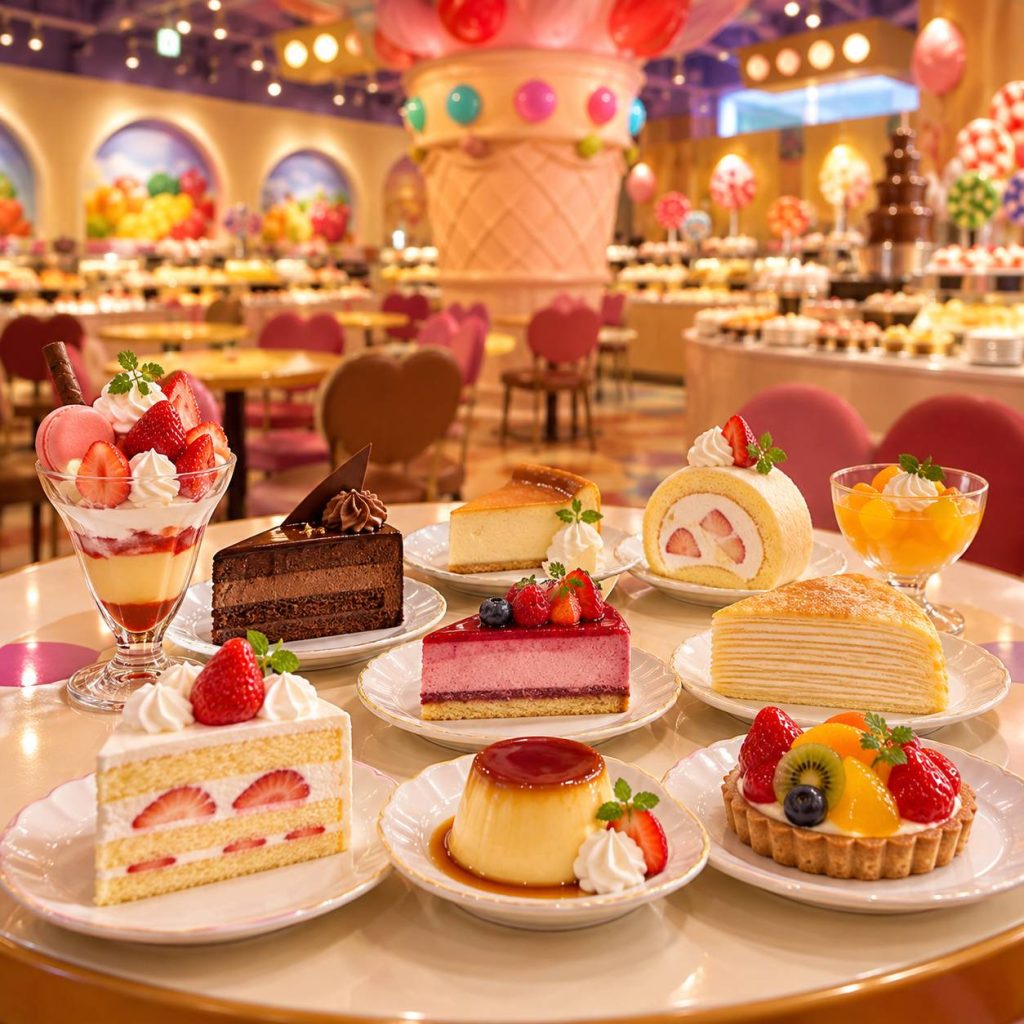
Some locations use a traditional buffet while others now use an order format, but the basic idea remains the same. Customers choose a timed course and get access to a rotating collection of cakes, puddings and other sweets, with higher tiers adding premium ice cream, fresh fruit and other extras.
And Sweets Paradise actually publishes the lineup. Its current autumn rotation includes pumpkin mousse cake, caramel-and-apple royale, muscat-and-Kyoho grape mousse cake, matcha chiffon, chestnut-and-purple-sweet-potato Mont Blanc tart, sweet-potato-and-raisin cake, creamy black-sesame pudding and an orange baked sweet. Earlier seasonal runs have moved through strawberry mousse cakes, strawberry-and-sakura cakes, mango mousse, peach-yogurt cake and fruit tarts.
The chain has become especially creative with fruit. Its premium Fruit Paradise courses rotate through all-you-can-eat seasonal offerings such as strawberries, peaches, melons and mangoes, alongside the regular sweets buffet.
The entry-level Sweets Paradise course currently begins at 1,790 yen on weekdays – about $12 – and runs for 70 minutes.
Which raises an obvious question.
How much cake does one actually want in 70 minutes?
Sweets Paradise has thoughtfully provided an answer: probably not cake alone.
Why Is There Pasta at the Cake Buffet?
One of the charming things about Sweets Paradise is that the menu also includes savory food.
Pasta. Curry. Soup. Salad. Depending on the promotion, even rice balls and pork soup can appear alongside the cakes The savory side changes with the season too. A current rotation includes salmon-and-lotus-root cream pasta, sausage-and-sweet-potato curry, mushroom-and-daikon consomme and mixed rice with pork and greens. The point is not to disguise a regular buffet as a dessert restaurant. It is to give the sugar some competition.
At first this seems almost like a loss of nerve.
You named the restaurant Sweets Paradise. Why is there curry?
Then you eat three pieces of cake and understand immediately.
Savory food is not a distraction from the dessert buffet. It is maintenance equipment.
A little salt, a little pasta, a French fry, and suddenly the next piece of cake looks entirely reasonable again.
So a restaurant concept that began as casual unlimited cake has gradually become something closer to an all-you-can-eat sweets playground.
Japan Also Turned Dessert Buffets Into a Calendar
Sweets Paradise is the everyday version.
Japan’s hotels take the same idea and dress it for company.
At Sunshine City Prince Hotel in Tokyo, dessert buffets operate almost like seasons on a calendar. In 2026, a Strawberry & White Chocolate Sweets Buffet ran from March into May. The next day, essentially, the hotel moved into Melon & Cherry. In July, that gave way to a Summer Color Sweets Festival.
These are not little dessert add-ons to dinner.
They are scheduled afternoon dining experiences, commonly running 90 minutes and costing around 5,000 to 5,500 yen for an adult – roughly $32 to $35.
The menus are wonderfully literal about the theme. A recent Strawberry & White Chocolate edition included strawberry shortcake, raspberry macarons, strawberry pie, panna cotta with strawberry jelly, white souffle cheesecake, white caneles and a strawberry-white-chocolate Mont Blanc. Even the savory counter joined in with dishes such as strawberry-accented smoked-salmon croissant sandwiches and Wagyu beef shank braised with cacao and red wine.
The buffet itself becomes the event.
The pastry team gets a theme. The room gets a mood. Fruit becomes seasonal programming.
And when strawberry season ends, nobody packs away the buffet.
They change the fruit.
Seoul Has a Dessert-Buffet Season
South Korea takes this seasonal idea even further.
In Seoul, luxury-hotel strawberry buffets have become a recurring winter and spring ritual.
That sentence deserves a second look.
Strawberry-buffet season.
Major hotels build entire experiences around premium Korean strawberries: fresh berries, strawberry cakes, tarts, mousses, pastries and carefully styled displays. Reservations can become events in themselves, and the prices are firmly in luxury territory.
At The Grand Lotte Seoul in 2026, the Peninsula Lounge offered its Must Be Strawberry buffet through April at 140,000 won per person – about $102.
Recent versions have included premium strawberry cake, strawberry mille-feuille and strawberry chocolate fondue, backed up by a savory side substantial enough to include dishes such as grilled lamb chops, carved beef steak and kimchi fried rice.
Then May arrived.
The strawberry buffet became a mango buffet.
The hotel’s Must Be Mango program ran on weekends and holidays through August, again at 140,000 won – about $102 – with a 2.5-hour format. Mango became the organizing idea, while the savory side ranged from mango shrimp to roast beef, lamb chops and beef lasagna.
That tells us something important.
In this corner of Seoul, dessert buffet is not one promotion. It is a recurring luxury dining format that changes with the produce calendar.
Hong Kong Will Build a Buffet Around Durian
Hong Kong offers another version, and it may be the most wonderfully specific.
At The Harbourview in Wan Chai, the hotel runs themed dessert buffets on weekend afternoons for months at a time.
In summer 2026, the theme was durian.
Not a dessert buffet with one durian cake tucked in the corner.
A Feast of Durian Dessert Buffet.
For Saturday and Sunday afternoons from June through August, the spread revolved around durian desserts – reported examples have included D24 durian pudding, Monthong durian cheesecake, durian mousse, durian mille-crepe cake and durian ice cream – accompanied by Chinese sweet soups, salads and unlimited coffee or tea.
The promotional online price was HK$194 per person, about $25, with the regular price at HK$228, about $29, before service charge.
Then the durian season ended and the dessert buffet did not.
September brought a new theme: Purple Mermaid’s Treasure, an undersea fantasy built around naturally purple ingredients.
This may be the purest expression of the hotel dessert buffet as entertainment.
The basic product is not simply cake.
It is: what strange and beautiful sweet world are we entering this weekend?
London Has a Simpler Proposition: Bottomless Cake
London, meanwhile, has found a much more direct formulation.
Jack & Beyond in Battersea calls its experience Bottomless Cake.
There is very little ambiguity here.
For 90 minutes, guests can eat unlimited slices from a rotating selection of six or seven cakes. Groups begin with a sharing plate so everyone can taste the lineup, then order additional slices one at a time. The exact selection changes, but the bakery’s house repertoire includes flavors such as pistachio and raspberry, carrot and cinnamon, red velvet, frosted Victoria, tiramisu, lemon and double chocolate.
The current price is 26 pounds per person – about $35.
The bakery even keeps track of the record.
Twenty-seven slices.
There is something almost scientifically useful about a restaurant establishing the outer boundary of human cake ambition.
The format is also revealing because it strips the dessert buffet down to its simplest possible form. No ballroom. No themed fruit season. No hotel lobby waterfall.
Cake.
More cake.
Would you like another piece of cake?
France Has a Surprisingly Matter-of-Fact Version
Then there is France, where unlimited dessert can appear with considerably less ceremony.
At some French casual restaurants, the dessert buffet is simply a course.
Campanile Paris Est-Bobigny, for example, currently lists a standalone buffet des desserts a volonte – an unlimited dessert buffet – for 12.95 euros, about $15. The restaurant simply describes it as a seasonal unlimited dessert buffet; it can also be bundled with starters or a hot main.
Other French family restaurants use a similar model: choose a meal, then help yourself to the dessert buffet as often as you like.
That is a very different cultural expression from Japan’s Sweets Paradise or Seoul’s luxury strawberry season.
There is no need to explain the concept dramatically.
It is simply dessert.
At a buffet.
And yes, you may have more.
A Buffet Concept You May Not Have Seen Yet
The interesting thing about dessert buffets is that there is no single global model.
Japan made unlimited sweets into a restaurant chain.
Tokyo hotels turned pastry into seasonal programming.
Seoul made strawberries and mangoes into luxury buffet seasons.
Hong Kong builds rotating weekend fantasy worlds around fruit and color.
London offers 90 minutes of bottomless cake.
And in parts of France, unlimited dessert can be as ordinary as choosing it from the menu.
They all arrive at the same idea from completely different directions.
The dessert station does not have to be where the buffet ends.
Sometimes it can be why the buffet exists.
For anyone whose idea of unlimited dessert still begins with a soft-serve machine beside the exit, there is apparently an entire sweeter branch of all-you-can-eat culture waiting to be discovered.