If you spend enough time driving across Iowa, Minnesota, the Dakotas or Wisconsin, something curious begins to happen.
Pizza Ranch stops looking like a restaurant chain you have discovered and starts looking like part of the landscape.
There it is outside Sioux Falls. There it is in an Iowa town that may not have many other national restaurants. There it is again a couple of hours later, this time attached to a brightly lit arcade called a FunZone.
If most of your life has been spent on either coast, however, the name can produce an entirely different reaction.
Pizza Ranch?
There are no Pizza Ranch restaurants in California, Oregon or Washington. None in New York, New Jersey, Pennsylvania or Florida. The chain spent more than four decades becoming very large without becoming remotely coast-to-coast.
And it is large. By mid-2026, Pizza Ranch reported 221 restaurants and 105 FunZone arcades. Technomic estimated the chain generated $362 million in U.S. sales in 2024. That is not a roadside curiosity with a few loyal outposts.
It is one of the bigger all-you-can-eat restaurant organizations in America.
Yet plenty of Americans have never encountered one.
That makes Pizza Ranch interesting before we even get to the fried chicken.
Start With a Town That Had No Pizza
Pizza Ranch begins in Hull, Iowa, a small town in the northwest corner of the state.
In 1981, 19-year-old Adrie Groeneweg had noticed something remarkably straightforward: people from Hull were leaving town when they wanted pizza. He was working as a welder and had also spent time working in a pizza restaurant. His father, Bill, thought there might be a business in bringing the pizza closer to home.
Bill found a building on Main Street, backed his son and signed the bank note at an interest rate of 18 percent. The family came up with a Western theme. Adrie developed the recipes – only six specialty and single-topping pizzas at the beginning – and the first Pizza Ranch welcomed its first guest on December 21, 1981.
There is something wonderfully un-corporate about the beginning.
No national market study. No celebrity chef. No carefully staged launch into a major metropolitan area.
A town needed pizza.
A teenager decided to open a pizza restaurant.
Then the thing kept growing.
A second Pizza Ranch opened in Orange City, Iowa, in 1983. The first franchise followed in Mountain Lake, Minnesota, in 1984. By the company’s fifth anniversary there were 10 locations. By its tenth, there were 52 restaurants across five states. The count reached 80 by 1996 and 100 in 2003.
By 2011, Pizza Ranch had 160 restaurants.
The remarkable part is not simply that it grew.
It is where it grew.
The Map Explains the Mystery
Most restaurant chains become familiar to America by concentrating first in large cities, suburbs and highly visible commercial corridors. Pizza Ranch followed almost the opposite path.
Its early strength was small-town Midwestern America.
Groeneweg later described the chain’s niche as communities of 5,000 people or fewer – towns that larger competitors often did not want. Some Pizza Ranch markets had populations closer to 1,000. In 2022, company executives said roughly half of the system was still operating in communities with fewer than 15,000 residents.
Think about what that does to national visibility.
A chain can become deeply familiar across Iowa and the Dakotas without ever becoming part of the everyday restaurant vocabulary in Boston, New York, Miami, Seattle or Los Angeles.
Even today, the concentration is remarkable. Iowa, Minnesota, Wisconsin, South Dakota and North Dakota account for roughly three quarters of the operating system. Iowa alone has dozens of Pizza Ranch restaurants.
That density changes the way the brand feels.
In its home territory, Pizza Ranch can be the place after a high-school game, the restaurant with a room large enough for a family gathering, the dinner stop after a day on the road, or the familiar buffet where children know exactly where the Cactus Bread will be.
Outside that territory, it can be completely invisible.
Pizza Ranch did not become obscure because it failed to grow.
It became large in a part of America that national restaurant culture sometimes forgets to look at.
The Buffet Wasn’t Supposed to Take Over
Pizza Ranch also became a buffet company somewhat reluctantly.
The second restaurant introduced a buffet in 1983, but the early version was not yet the all-day identity Pizza Ranch would eventually adopt. Groeneweg was wary of pushing the format too far. Buffets could suggest food that sat too long, dining rooms that became messy and a general lowering of quality.
Then a franchisee tried an all-day buffet anyway.
Sales jumped by roughly 23 to 24 percent.
That is the kind of number that can make a philosophical objection considerably less philosophical.
Other restaurants saw similar results, and Pizza Ranch gradually became what it had not originally intended to be: a restaurant built around unlimited dining.
The buffet worked particularly well with pizza because it turned variety into the attraction. A customer did not have to order an entire taco pizza simply to discover whether taco pizza was a good idea. One slice could answer the question.
Pizza Ranch eventually refined that freedom with one of its smartest inventions, Buffet Your Way.
The idea is simple. If the pizza you want is not on the buffet, ask for it. The kitchen makes the pizza, and the person who requested it gets the first slice before the rest goes onto the buffet.
This solves one of the oldest frustrations of the pizza buffet.
You no longer have to stand near the line quietly hoping somebody eventually makes what you actually wanted.
You can just ask.
And Then Fried Chicken Changed the Restaurant
Here is where Pizza Ranch becomes something stranger than its name suggests.
In 1987, fried chicken joined the menu.
That idea, too, came from outside the corporate office. A restaurant in Sioux Falls was converting to Pizza Ranch but wanted to keep serving the fried chicken it had already been making. Groeneweg later recalled noticing how much busier the restaurant became at noon and realizing the chicken was driving business.
Pizza Ranch developed its own recipe and made fried chicken part of the system.
It became important enough that Groeneweg has joked the company might have been better named Chicken Ranch.
Spend a little time around Pizza Ranch devotees and the joke starts to make sense.
The chicken is not a side attraction parked at the end of a pizza buffet. It is one of the principal reasons the buffet works. Pizza Ranch calls it Crispy Ranch Chicken and serves it beside mashed potatoes and gravy, potato wedges, vegetables, biscuits and other familiar hot sides.
There is a useful bit of psychology in that combination.
One person can be in the mood for pizza. Another can want a fried-chicken dinner. A child can eat two slices of cheese pizza and then move directly to dessert. Someone else can build a salad and pretend the plate of mashed potatoes arriving five minutes later was never part of the plan.
They can all go to the same restaurant.
That is classic buffet logic.
Pizza Ranch just built it around a pairing that sounds unusual until you have seen how naturally pizza and fried chicken coexist on the same line.
What You Actually Eat at Pizza Ranch
The modern Pizza Ranch buffet is easier to understand if you stop thinking of it as a pizza buffet and start thinking of it as several familiar American meals occupying the same room.
There is pizza, of course.
The menu still carries names that fit the Western branding. The Bronco is an all-meat pizza with beef, sausage, pepperoni, Canadian bacon and bacon. Texan Taco combines beef, lettuce, tomatoes, two cheeses, taco sauce, red onion and taco chips. Chicken Bacon Ranch does exactly what its name promises. Tuscan Roma heads in a different direction with tomatoes, spinach and Alfredo sauce.
Some local menus go farther.
Yes, there are Pizza Ranch restaurants where macaroni-and-cheese pizza appears among the specialty choices.
This is a buffet. Curiosity is allowed.
Then there is the chicken and the hot-food side of the restaurant: mashed potatoes and gravy, wedges, green beans, corn, biscuits and other items that can make a plate look much closer to a family-style chicken dinner than a trip to a pizza shop.
A salad bar supplies the greens, vegetables and toppings.
And then there is Cactus Bread.
Cactus Bread is Pizza Ranch’s signature dessert pizza: a warm crust covered with cinnamon streusel and icing. Fruit dessert pizzas – apple, blueberry and cherry among them – extend the idea, and some locations add soft-serve ice cream.
The combination is almost perfectly engineered for the low-stakes experimentation that makes buffets enjoyable.
Try a slice of Texan Taco. Take a piece of fried chicken. Add a spoonful of potatoes. Decide halfway through the meal that you apparently needed a slice of Cactus Bread after all.
Nothing requires a commitment larger than the space left on the plate.
The Restaurant Is Part of the Product
Pizza Ranch still describes many of its restaurants as casual, American West-inspired places, and the Western language runs through almost everything: Ranch, Bronco, Stampede, Prairie, Ranch Rewards, Ranch Stix.
But the more important design idea is not the cowboy theme.
It is gathering.
Many Pizza Ranch restaurants include community rooms that can hold birthday parties, reunions, school groups, team dinners, meetings and other local events. The company has been building fundraising into the business since its early years; coupon books were introduced by the fifth anniversary, and its current Community Impact events allow local groups to help serve guests while receiving donations and a share of qualifying sales.
Pizza Ranch says those fundraising programs now generate more than $1.1 million a year for local organizations and causes.
That number matters, but the structure may matter more.
The restaurant is deliberately useful to the community around it.
Pizza Ranch talks constantly about giving guests a ‘legendary experience,’ which sounds like ordinary restaurant marketing until you look at how the company has built the physical restaurants. The buffet, community rooms, group dining, fundraising nights and increasingly the arcade all encourage people to remain in the building longer than it takes to eat two slices of pizza.
In many small markets, Pizza Ranch functions less like a quick meal stop and more like a local family dining hall with fried chicken.
That may be one reason the concept has been so durable in places where community institutions matter.
Then Pizza Ranch Discovered the Arcade
The next transformation may be nearly as important as the buffet and the chicken.
Pizza Ranch began adding FunZone arcades to restaurants, turning part of the building into a family entertainment center with redemption games, prizes and party space.
At first, this could look like a familiar restaurant amenity – a larger version of the game room attached to plenty of family pizza places.
It did not stay small.
Pizza Ranch reported 59 FunZones in 2022.
In February 2026, the chain opened its 100th FunZone in Council Bluffs, Iowa. That arcade alone spans more than 3,000 square feet, includes more than 45 games and has three party rooms.
By mid-2026, Pizza Ranch was reporting 105 FunZones.
In other words, the arcade count nearly doubled in about four years.
And these are not decorative game corners.
Pizza Ranch’s 2026 franchise disclosure information reported that 85 established FunZones averaged about $339,000 in arcade-only revenue during 2025. Ninety-four franchised Pizza Ranch restaurants with FunZones averaged a little more than $2.1 million in total annual sales.
Those figures do not prove that adding an arcade automatically produces a more successful restaurant. FunZone locations can differ in size, market and age from stores without them.
But $339,000 in average arcade revenue does establish one thing rather clearly.
The games are a business.
Pizza Ranch’s current development material contemplates restaurants of roughly 4,800 to 6,200 square feet, with another 1,200 to 3,000 square feet available for a FunZone.
That is a very different proposition from the little Hull pizza restaurant of 1981.
Growing, But Not Quite the Way You Might Think
It is tempting to look at Pizza Ranch today and describe it as a chain exploding across America.
The numbers tell a more nuanced story.
Technomic counted 218 U.S. restaurants in 2024. Pizza Ranch was reporting 221 operating restaurants by mid-2026.
That is growth, but it is not a unit-count stampede.
The more dramatic expansion is happening inside the concept itself.
FunZones have multiplied. The restaurant prototypes have become larger. Carryout, delivery and other off-premise business became more important after the pandemic forced a buffet-centered company to operate without depending entirely on people standing in front of a steam table. Pizza Ranch is also preparing a systemwide technology modernization, with a new point-of-sale platform scheduled to begin rolling out in 2027.
So the story is not simply that Pizza Ranch is opening restaurants quickly.
It is that a mature regional chain is becoming a more complicated business while carefully pushing the edges of its map.
And in September 2026, one of those edges moved quite a bit.
Texas Opens the Next Chapter
On September 21, 2026, Pizza Ranch opened in Tyler, Texas.
It is the chain’s first Texas restaurant.
The location is not a tentative little storefront. State project records describe an 11,435-square-foot restaurant-and-arcade conversion, and the finished Pizza Ranch includes both the buffet and a FunZone.
That makes Tyler a particularly useful symbol of what modern Pizza Ranch is trying to become.
Pizza. Fried chicken. Salad. Cactus Bread. Games. Parties. Group dining. Carryout. Catering.
All under one Western-themed roof.
Texas also appears to be more than a one-restaurant experiment. Pizza Ranch lists Waco as coming soon, and company recruiting materials describe that restaurant as a new corporate-owned location. A separate Texas construction filing shows a new 9,644-square-foot Pizza Ranch project in Royse City, east of Dallas.
Elsewhere, the chain’s official coming-soon list includes Idaho Falls, Idaho; Jefferson City, Missouri; Kenosha and Wisconsin Rapids, Wisconsin; along with Waco.
The company’s franchise territory map also lists most Texas markets as available for development.
That does not mean Pizza Ranch is about to appear in every major American city.
In fact, its measured expansion may be part of what has protected the brand. Pizza Ranch spent decades building density and familiarity in markets it understood rather than racing toward a national map simply because national maps look impressive.
But Texas is still a notable step.
For the first time, a restaurant company that became enormous in the Upper Midwest is introducing itself to a major new state with almost none of the inherited familiarity it enjoys back home.
The Chain You Discover by Driving Through the Middle
Perhaps the most interesting thing about Pizza Ranch is that its obscurity and its success are not contradictions.
They are products of the same strategy.
Pizza Ranch grew by serving places that bigger restaurant companies often overlooked. It became familiar town by town, franchise by franchise, across a broad interior stretch of the country. Its customers did not need the chain to be famous in New York or Los Angeles.
They needed it to be good at being the Pizza Ranch in their town.
Along the way, the restaurant kept changing.
The pizza place added a buffet.
The buffet added fried chicken.
The buffet learned to make the pizza you request and save you the first slice.
The restaurant added community rooms.
The game room became an arcade business.
And now the map is beginning to move south.
There is something very American about discovering a restaurant chain this way – not from a national advertising campaign, but by driving through the middle of the country and eventually wondering why the same name keeps appearing.
Then you walk inside.
You find taco pizza beside fried chicken, mashed potatoes near the salad bar, cinnamon-streusel Cactus Bread waiting at the end, and perhaps 3,000 square feet of blinking arcade games beyond the dining room.
And you realize that the regional restaurant you had somehow never heard of has been building its own version of abundance for more than four decades.
Much of America simply hasn’t met it yet.
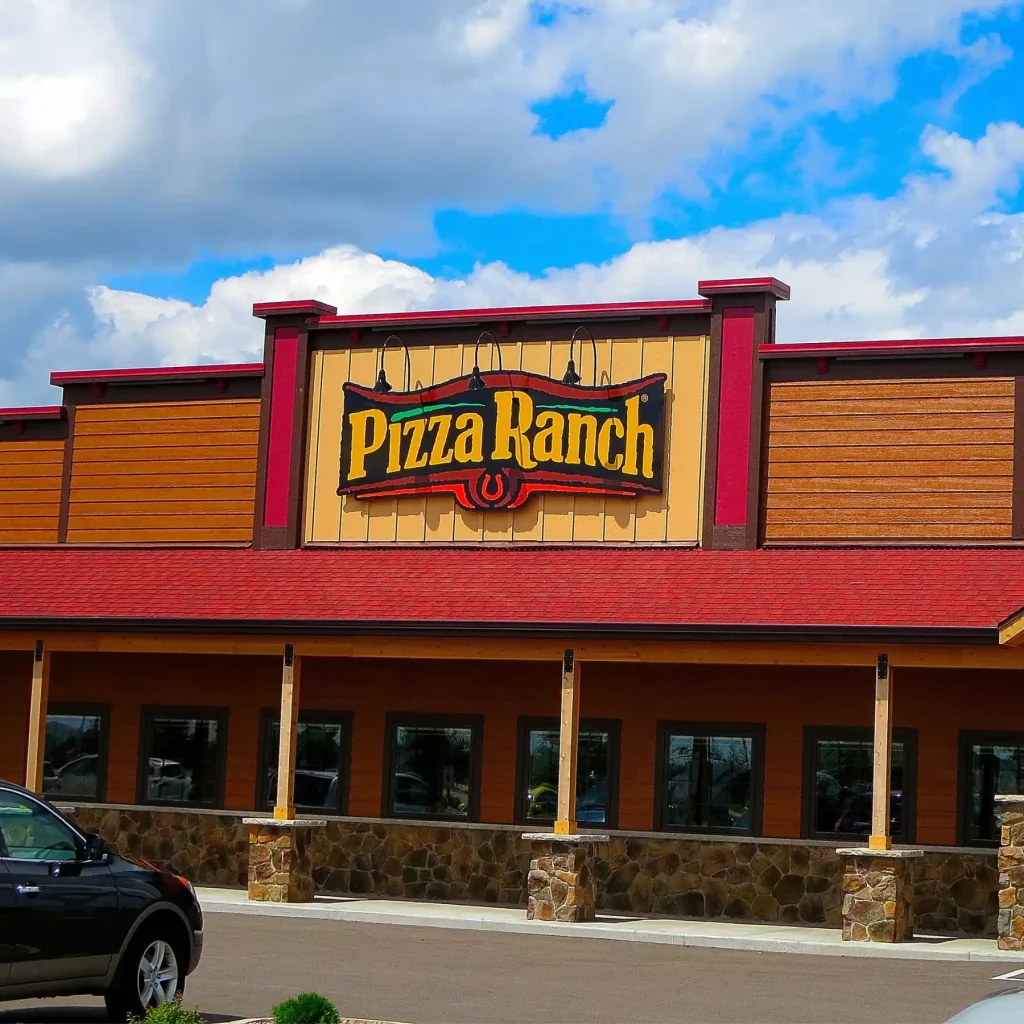
Photo credit: Corey Coyle, “Pizza Ranch – panoramio,” via Wikimedia Commons, CC BY 3.0. Cropped from original.