
Cuisine
Meal Periods
Dining Format
Price Range
$24 - $28
Website
Cuisine
Meal Periods
Dining Format
Price Range
$24 - $28
Website
EXPERIENCE
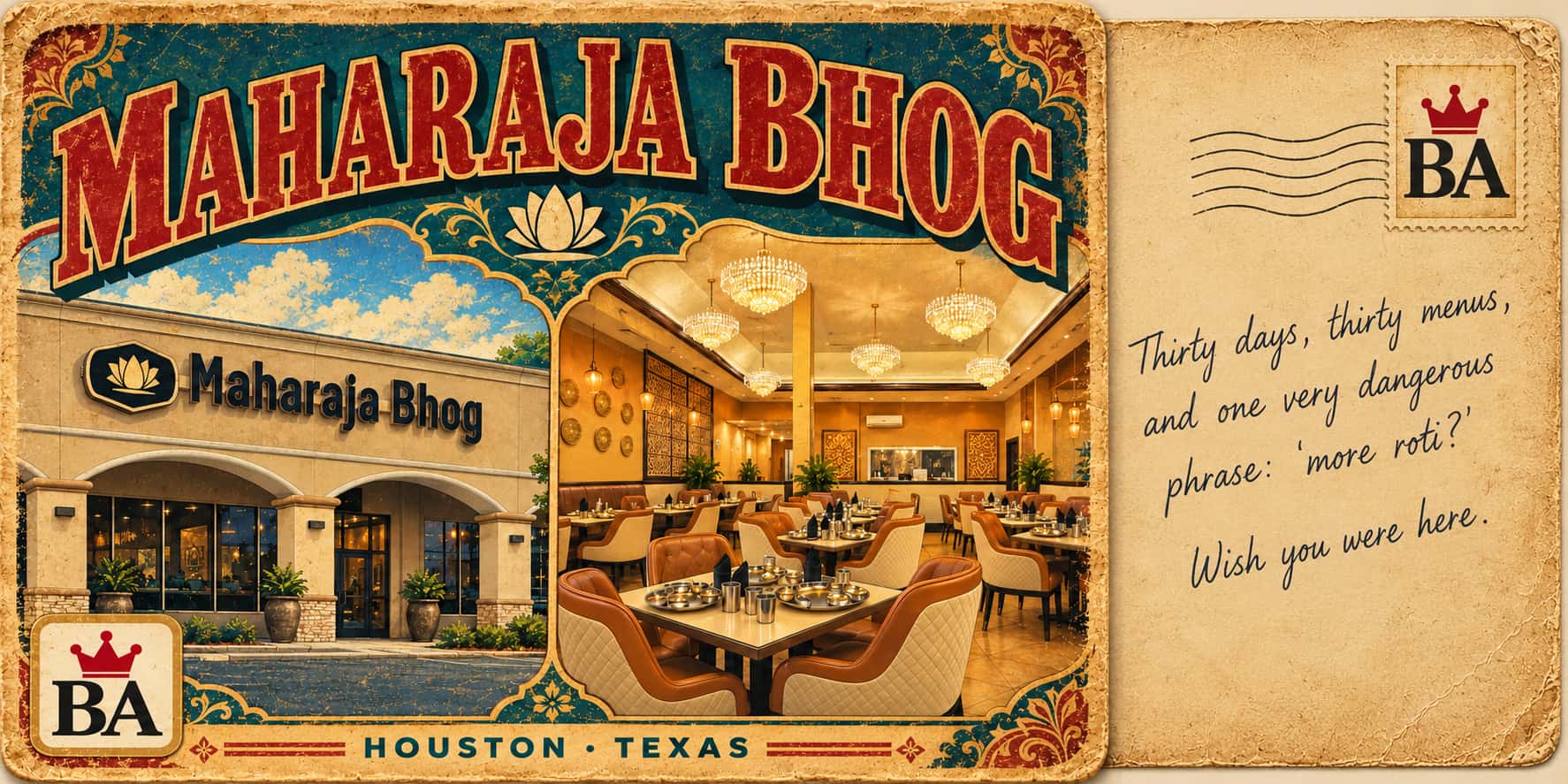
Maharaja Bhog is one of Houston’s clearest examples of all-you-can-eat dining as ceremony rather than self-service. The India-headquartered company was founded in 2012 by Ashish Maheshwari, and Houston remains its only U.S. location within a small international group that also reaches India, Dubai and Mississauga. The Houston restaurant has been here since the concept’s early years, yet it still feels unusual: a polished vegetarian dining room devoted to one elaborate regional meal.
The room gives that meal an appropriately dressed-up stage. Gold-toned banquettes, warm neutral finishes and modern pendant lighting push the atmosphere closer to a special-occasion restaurant than a utilitarian buffet room. At the table, a large metal thali arrives ringed with small bowls, and from there the restaurant takes control of the choreography. Servers circulate with breads, dals, kadhi, vegetables, rice, sweets and drinks, filling and refilling the platter rather than sending guests to a buffet line.
That service is the real meaning of Maharaja Bhog’s “royal” idea. The company roots its hospitality in Atithi Devo Bhava — the Indian principle that the guest is treated with reverence — and the unlimited format makes attentiveness part of the mechanics. A nearly empty bowl invites another ladle; roti and puri keep coming; chaas can be replenished again and again. The pace can be brisk because the meal is built around circulation, not waiting for individual courses.
The result is abundance without browsing. You do not wander a steam-table landscape deciding what the restaurant is today; the kitchen has already composed that day’s thali. Your choices happen at the table: what to combine, what to revisit and, eventually, what to wave away. That makes Maharaja Bhog fundamentally different from the familiar Indian lunch buffet. The unlimited part is recognizable. The ritual around it is the destination.

FOOD
A thali is not one particular dish. It is a complete meal served together on a large platter, usually with several small bowls arranged around it. Those bowls might hold lentils, vegetables, yogurt-based dishes or something sweet, while breads, rice, pickles and crunchy accompaniments fill out the plate. Thalis vary across India because each region builds the meal around its own cooking traditions. Maharaja Bhog focuses on the vegetarian food of Gujarat and Rajasthan, two western Indian states with different but complementary styles.
That is also why eating here feels different from visiting a typical Indian lunch buffet. You do not walk along a steam table and choose from dozens of pans. The kitchen decides the day’s menu, servers bring small portions of everything to your table, and you can ask for more of whatever you like. It is still all-you-can-eat, but the restaurant introduces the meal to you instead of asking you to build it yourself.
The Gujarati side of the meal tends to bring more vegetables and a mix of sweet, tangy and savory flavors. Dhokla, for example, is a soft steamed cake made from chickpea flour. Undhiyu is a hearty mixed-vegetable dish and one of Gujarat’s best-known specialties. Gujarati dal is a lentil dish that can taste slightly sweet as well as spicy and tart, while khichdi combines rice and lentils into something mild and comforting. Chaas, a thin spiced buttermilk drink, helps cool the palate between richer or hotter bites.
Rajasthani dishes can feel a little heartier. Gatta curry uses small chickpea-flour dumplings in a flavorful sauce. Dal baati churma, one of the region’s signature combinations, brings together lentils, baked wheat rolls and a sweet crumbled wheat mixture. Kadhi is a tangy yogurt-based sauce thickened with chickpea flour. Fresh roti and puffed fried puri arrive alongside these dishes, giving you bread for scooping up curries, lentils and sauces.
A newcomer does not need to memorize all of the names to understand the plate. Think of it as several categories arriving together: a few snacks, vegetable dishes, lentils, something creamy or tangy, rice, fresh breads and small portions of pickles or chutneys. The exact choices rotate, so one visit might bring a paneer dish, potato curry, steamed dhokla or mixed vegetables while another meal takes a different direction. The condiments matter too; a little pickle, chutney or crisp papad can add heat, tartness or crunch to an otherwise soft bite.
Dessert is part of the spread rather than a separate final course. Jalebi brings crisp, syrup-soaked spirals; halwa is a soft, rich sweet; and milk-based desserts such as basundi, rabdi or ras malai may appear in the rotation. Part of the fun is moving back and forth between flavors rather than eating everything in a strict order. Something sweet can follow something spicy, then a cooling sip of chaas sends you back toward the savory dishes again.
Maharaja Bhog calls its rotation “30 Days, 30 Different Menus.” The basic shape of the meal stays familiar — snacks, vegetables, lentils, rice, breads, condiments, a drink and something sweet — but the individual dishes change. That makes the unlimited format less about facing an enormous buffet all at once and more about exploring one thoughtfully assembled regional meal, then asking for seconds of the things you like best.
FOOD HIGHLIGHTS
♛ Daal Baati Churma — lentils served with baked wheat rolls and a sweet crumbled wheat mixture, one of Rajasthan’s signature combinations.
♛ Surti Undhiyu — a hearty Gujarati specialty built around a mixture of vegetables cooked with spices.
♛ Rajasthani Gatta — chickpea-flour dumplings served in curry, giving the meal a distinctly Rajasthani flavor.
♛ Khaman Dhokla — soft, fluffy steamed chickpea-flour cake with a mild savory tang.
♛ Dahi Vada — soft lentil fritters covered with cool yogurt and sweet-tangy chutneys.
♛ Gujarati Dal — a lentil dish with an unusual balance of mild sweetness, spice and tartness.
♛ Rajasthani Kadhi — a tangy yogurt-based sauce thickened with chickpea flour.
♛ Moong Dal Khichdi — rice and lentils cooked together into a mild, comforting dish.
♛ Fresh Roti — soft whole-wheat flatbread made for scooping up curries, vegetables and lentils.
♛ Puri — puffed fried bread with a crisp outside and tender center.
♛ Chaas — thin, cool spiced buttermilk served as a refreshing break between richer dishes.
♛ Jalebi — crisp spiral-shaped sweets soaked in syrup for a bright hit of sweetness.
LATEST FROM THE WIRE

September 6, 2026
Mandarin Brings Back Its Moon Festival Buffet September 8
New Duck Bao joins returning seasonal favorites during the Ontario chain’s fall tradition.

September 5, 2026
Uno Pizzeria Joins the AYCE Ranks With $14.99 Bottomless Deep Dish
The 10-week promotion starts today at 21 restaurants after Uno’s $99 Pizza Pass sold out.

NEWEST RESTAURANT PROFILES
The Original Benjamin’s Calabash Seafood
Myrtle Beach,
South Carolina
Sunny Side Up Grill
Little River,
South Carolina
Simply Southern Smokehouse
Myrtle Beach,
South Carolina

Sea Captain’s House
Myrtle Beach,
South Carolina