
Cuisine
Meal Periods
Dining Format
Price Range
$14 - $18
Website
Cuisine
Meal Periods
Dining Format
Price Range
$14 - $18
Website
EXPERIENCE
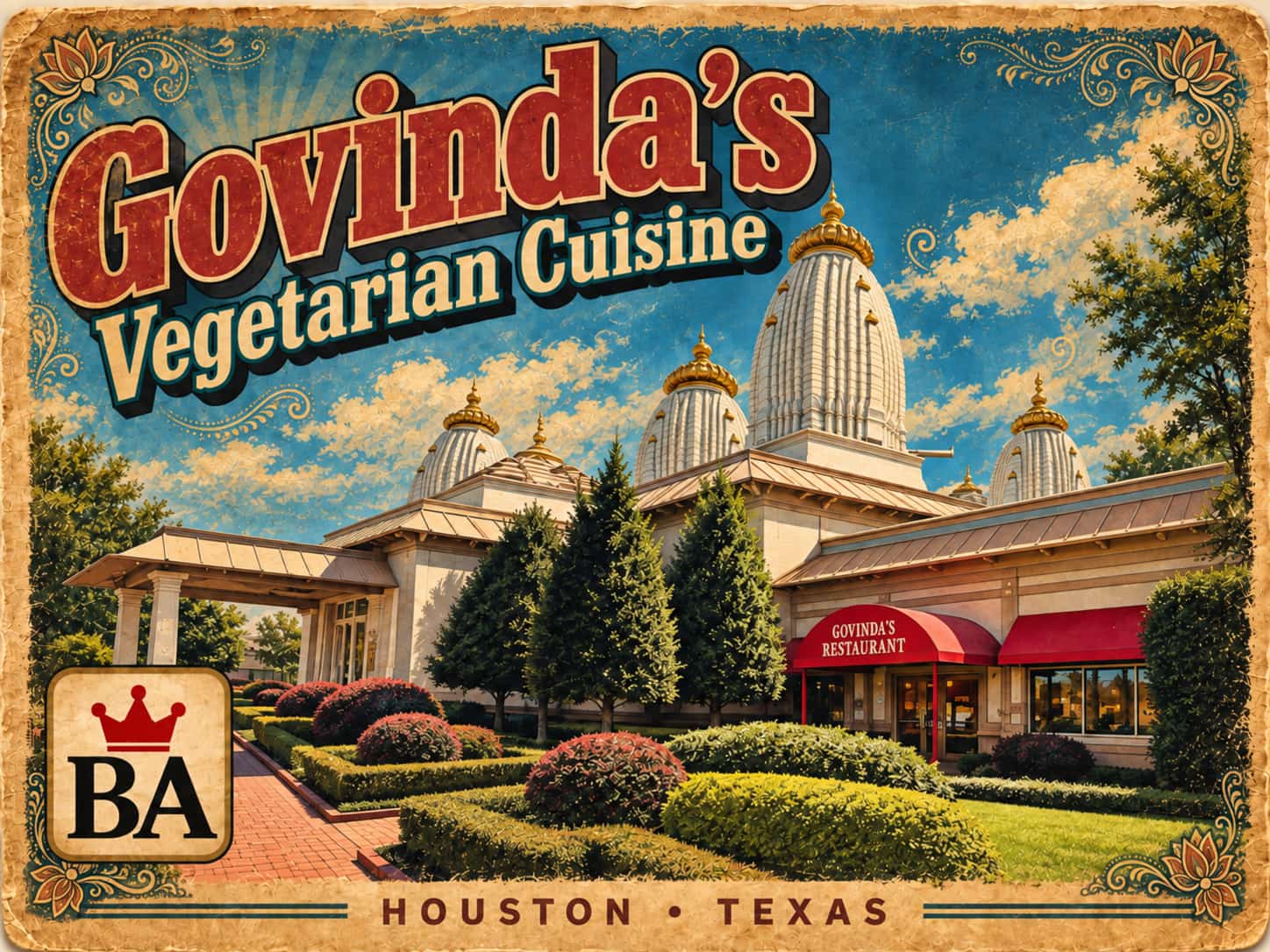
Govinda’s has one of Houston’s more unusual buffet rooms because the restaurant is not merely beside the ISKCON temple; it occupies the community’s former temple space. When the current Radha-Nila-Madhava temple opened in 2014, the old room was remade as the restaurant, with Gensler handling the build-out. Ornate octagonal ceiling domes survived that transition, but the rest reads clean and contemporary: polished floors, modern ring lights, broad windows, bold wall graphics and a colorful Krishna mural rather than the visual clutter of a conventional buffet hall.
The buffet follows that same sense of order. Instead of islands scattered through the dining room, the food runs in a long, one-sided line, with the kitchen facing the room from the opposite side. Take a plate, move through the day’s sequence, then settle at a table while hot chapatis arrive from the kitchen. The arrangement makes the buffet and kitchen feel like one working food operation rather than two separate zones.
There is a calmness here that matters. Temple architecture, gentle devotional cues and a dining room built for conversation give Govinda’s a more settled rhythm than most all-you-can-eat restaurants. The spiritual identity is present without turning the meal into a lesson. Above the buffet, imagery of a leaf, flower, fruit and water makes a quiet Bhagavad-gita reference, while the room itself keeps the message broad and welcoming.
That balance has been part of Govinda’s since its 2016 opening. The original idea was broader than an Indian restaurant, but the buffet quickly found its center in Indian cooking while keeping room for occasional global detours. What emerged is less a giant buffet than a disciplined one: vegetarian by definition, completely vegan three days each week, and shaped by the kind of hospitality where another warm chapati can arrive before the plate is finished.

FOOD
Govinda’s food is built around a constraint that becomes its personality: the entire restaurant is vegetarian, and the kitchen uses no garlic, onions or mushrooms. That gives the buffet the sattvic character associated with the temple’s cooking, where flavor has to come from spices, ginger, chiles, herbs, dairy where used, lentils and vegetables rather than the allium base that drives so much restaurant cooking. The result is recognizably Indian but different in its aromatic structure, and the daily rotation keeps that difference from becoming repetitive.
Start with the legumes and vegetable curries. Dal makhni combines black urad dal and kidney beans into a substantial anchor; chana masala brings chickpeas and spice; bhindi masala gives okra and potatoes their own lane. Baingan bhartha turns eggplant and tomato into a softer curry, while vegetable jalfrezi stays brighter and more intact. These are not side dishes orbiting a meat entree. They are the center of the meal.
On dairy days, paneer changes the buffet’s texture. Saag paneer folds cubes of cheese into creamy spinach, paneer makhni pushes toward tomato and butter, and paneer tikka masala adds bell pepper to the mix. Wednesdays, Fridays and Sundays switch the entire buffet to vegan cooking, so tofu and vegetable preparations take over the role paneer might otherwise play. Tofu curry with coconut milk and chickpea flour is particularly characteristic of the kitchen’s ability to make those vegan days feel like a different rotation, not a reduced one.
The rotation is also more eccentric than the words ‘Indian vegetarian buffet’ suggest. Recent menus have placed vada pav, spinach filo, lentil croquettes, tomato pasta and black-eyed peas alongside dal and paneer; other rotations have included tofu fillet with almond tartar sauce and vegetable chow mein. That fits the restaurant’s origin story: Govinda’s began with a broader, multinational idea before Houston’s response pulled it toward Indian food. The Indian core won, but the occasional sideways move never disappeared.
Fried and baked items keep the softer curries from controlling every plate. Mixed vegetable pakoras use chickpea-flour batter; samosas and papadam bring crunch; kadhi pakora sends fried chickpea-flour dumplings into curry gravy. Fresh chapati or roti is the defining service touch. Rather than leaving all the bread to wait under heat, the restaurant brings warm flatbread to the table, creating a small made-to-order moment inside an otherwise self-serve meal.
The cold side deserves more attention than buffet salad usually receives. Govinda’s treats salad as a real section, with chopped greens and vegetables plus house-made dressings such as avocado, tahini and mustard. The daily line can add soup or lighter vegetable preparations as well, giving the second plate an easy reset after paneer, dal and fried starters.
Dessert stays within the restaurant’s gently idiosyncratic range. Fruit halava can move through mango, pineapple or other variations; kheer or sweet rice supplies the dairy counterpart when the day is not fully vegan; eggless and vegan cakes rotate through flavors such as pineapple, chocolate, mango or blueberry. The signature here is not one permanent dish. It is the system itself: sattvic discipline, a daily-changing vegetarian spread, three fully vegan days, a few unexpected detours, and hot bread tying each return trip back to the kitchen.
FOOD HIGHLIGHTS
♛ Dal Makhni — black urad and kidney beans with slow, substantial depth.
♛ Bhindi Masala — okra and potatoes in a vegan, spice-driven preparation.
♛ Saag Paneer — creamy spinach and paneer on the dairy-day rotation.
♛ Baingan Bhartha — eggplant and tomato softened into a deep vegetable curry.
♛ Tofu Curry — coconut milk and chickpea flour give vegan days substance.
♛ BBQ Tofu — a tomato-sauced house staple with a decidedly Govinda’s twist.
♛ Vegetable Pakoras — chickpea-flour crunch against the softer curries and dal.
♛ Kadhi Pakora — fried chickpea-flour dumplings settling into curry gravy.
♛ Fresh Chapati — warm flatbread delivered from the kitchen to the table.
♛ Vada Pav — a Mumbai-style potato sandwich that can join vegan rotations.
♛ House Salad & Avocado Dressing — an unusually deliberate cold-side reset.
♛ Fruit Halava — semolina dessert rotating through mango, pineapple and other flavors.
LATEST FROM THE WIRE

September 6, 2026
Mandarin Brings Back Its Moon Festival Buffet September 8
New Duck Bao joins returning seasonal favorites during the Ontario chain’s fall tradition.

September 5, 2026
Uno Pizzeria Joins the AYCE Ranks With $14.99 Bottomless Deep Dish
The 10-week promotion starts today at 21 restaurants after Uno’s $99 Pizza Pass sold out.

NEWEST RESTAURANT PROFILES
The Original Benjamin’s Calabash Seafood
Myrtle Beach,
South Carolina
Sunny Side Up Grill
Little River,
South Carolina
Simply Southern Smokehouse
Myrtle Beach,
South Carolina

Sea Captain’s House
Myrtle Beach,
South Carolina